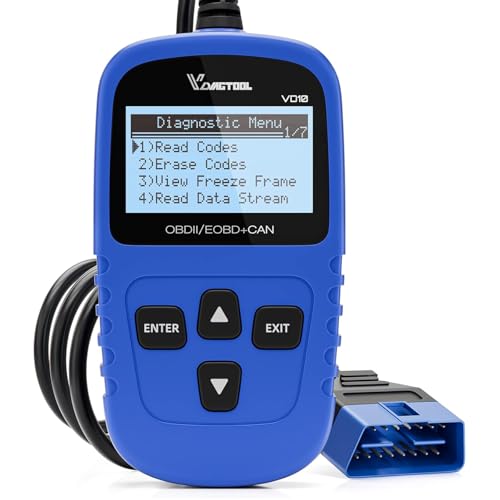
VDIAGTOOL VD10 is a straightforward OBD2 scanner review for drivers who want to read fault codes without adding an app or subscription.
If you want a simple way to check engine issues and inspection status, this one fits that job well.
VD10 OBD2 Scanner Review Summary
VDIAGTOOL VD10 is best for drivers who want a compact, self-contained scan tool for basic engine diagnostics.
It focuses on the core jobs most DIY owners actually need: read codes, clear codes after a fix, view live data, inspect freeze frame information, and check I/M readiness before an emissions test or inspection.
This is not trying to be a tablet-style all-system scanner.
It is a practical OBD2 code reader for people who want quick answers at the car, in the driveway, or before visiting a mechanic.
That makes it a strong fit for used-car checks, warning-light troubleshooting, and routine ownership rather than advanced technician work.
Review Scorecard
| Category | Score | Rationale |
|---|---|---|
| Ease of Use | 9/10 | Plug-and-play design with a 2-line display keeps basic diagnostics simple. |
| Core OBD2 Functions | 8/10 | Reads and clears codes, shows live data, freeze frame, and readiness status. |
| Everyday Buyer Fit | 9/10 | Well matched to drivers who only need essential engine diagnostics. |
| Feature Depth | 6/10 | Covers the basics well, but it is not aimed at advanced system access. |
| Inspection Help | 9/10 | I/M readiness support is directly useful before smog or inspection checks. |
| Compatibility | 8/10 | Supports standard OBDII protocols and a wide range of post-1996 vehicles. |
| Value for DIY Ownership | 8/10 | Focused feature set should suit buyers who prefer simplicity over complexity. |
The main reason to buy the VD10 is clarity.
It gives a driver enough information to understand whether a check-engine light is likely minor, pending, or worth immediate attention, without forcing a learning curve.
For everyday OBD2 diagnostics, that narrow focus is a strength.
Key Features and Specifications of VD10 OBD2 Scanner
The listing positions the VD10 as a universal OBD2 code reader for 12V cars, SUVs, and light trucks.
It supports CAN, ISO9141, KWP2000, J1850 PWM, and J1850 VPW protocols, and the compatibility claim extends to most OBDII-compliant vehicles: post-1996 US models, post-2006 EU models, and post-2009 Asian models.
It is designed around a simple display rather than an app or large touchscreen.
The product description calls out a clear 2-line LCD screen with white backlight and contrast adjustment, which matters when you want a quick read in a dim garage or during roadside troubleshooting.
Core functions listed for the VD10 include:
- Read diagnostic trouble codes
- Clear codes after repairs
- Display code definitions on the unit
- Show live data from vehicle sensors
- Retrieve freeze frame information
- Check I/M readiness status
- View vehicle information such as VIN, calibration IDs, and CVNs
The built-in code database is described as covering more than 3,000 codes.
That does not make it a full repair database, but it does reduce the need to look up basic definitions separately.
For a buyer comparing several inexpensive scanners, that built-in lookup is one of the more useful convenience features.
Another practical detail is power.
The unit is plug-and-play and does not require batteries or a charger.
For a tool that may be used infrequently, that is a real advantage because it is ready when the warning light appears instead of needing a separate charging routine.
Pros and Cons of VD10 OBD2 Scanner
Pros
- Easy to use for non-mechanics
- Reads, clears, and defines common codes on the device
- Live data and freeze frame help with basic diagnosis
- I/M readiness support is useful before inspection
- VIN and calibration information can help when checking a used car
- No battery or app setup required
Cons
- Not positioned as an advanced multi-system scanner
- Small 2-line display limits how much data you can review at once
- Best suited to engine-side OBD2 work, not deeper module diagnostics
- The feature set is practical, but not expansive
The biggest tradeoff is obvious: VD10 keeps the interface simple by staying narrow in scope.
Buyers who want a fast answer to a check-engine light will like that.
Buyers who expect bidirectional controls, ABS or airbag coverage, or smartphone-style visualization should look higher up the category ladder.
Who Should Buy VD10 OBD2 Scanner?
VDIAGTOOL VD10 makes sense for first-time DIY owners, commuter drivers, and anyone who wants a dependable basic scanner in the glove box or garage.
It is especially relevant if you want to confirm whether a warning light is something you can investigate yourself before paying for a shop diagnosis.
It also fits used-car shoppers.
The listing notes that it can retrieve vehicle information such as VIN and calibration data, which is helpful when you are checking whether the ECU matches the vehicle you are considering.
That is not a complete pre-purchase inspection on its own, but it is a smart extra check.
This is a good match for:
- Drivers who only need basic engine code reading
- Owners who want to clear codes after a verified fix
- People preparing for inspection or emissions testing
- DIY buyers who prefer a standalone tool over an app
- Used-car buyers who want quick verification data
It is less appropriate for:
- Professional technicians
- Buyers who need deep system coverage
- Users who want a large screen or graph-heavy interface
- Anyone expecting an advanced diagnostic tablet
**If your goal is simple ownership diagnostics, the VD10 is a practical fit.
If your goal is workshop-level diagnosis, it is too limited.**
How VD10 Handles Basic Car Diagnostics
Reading and Clearing Codes
The core appeal here is immediate fault-code access.
The listing says the VD10 reads generic and manufacturer-specific codes, including pending codes, and shows definitions on the screen.
That means you can go from a check-engine light to a first-pass diagnosis without reaching for a phone or a separate lookup.
Live Data and Freeze Frame
Live data helps you see what the engine is doing in the moment, while freeze frame preserves conditions from the fault event.
Those two features matter because they turn a code from a simple label into a more useful diagnostic clue.
For intermittent problems, freeze frame can be especially helpful because it captures context that may not appear again right away.
I/M Readiness for Inspection
The I/M readiness function is one of the best reasons to buy a basic scanner like this.
Before an emissions check, you want to know whether the monitors are ready rather than discovering a problem at the inspection station.
VD10 is built to answer that question directly.
Vehicle Information Checks
VIN and calibration ID retrieval are small but useful additions.
They can help confirm basic vehicle identity and ECU-related information, which is valuable when buying a used car or comparing records.
For many buyers, this is the kind of feature they do not think about until they need it.
Alternatives to VD10 OBD2 Scanner
If you want a more established name in the basic OBD2 category, consider BlueDriver.
It is often chosen by buyers who want app-based diagnostics with a more polished software experience.
For a similarly simple handheld route, AUTOPHIX OBD2 scanner is worth comparing.
It sits in the same general DIY-friendly space and may appeal if you want another compact code reader.
If you want broader enthusiast recognition, FIXD scanner is a familiar consumer option.
It is more app-centered and tends to appeal to drivers who want plain-language guidance.
For buyers who want a slightly more traditional handheld scan-tool style, ANCEL OBD2 scanner is another credible Amazon search starting point.
That brand is often compared by shoppers who want low-friction basic diagnostics.
The right alternative depends on whether you want handheld simplicity, app integration, or a more recognizable brand.
VD10 competes best on straightforward utility rather than on software depth.
Is VD10 OBD2 Scanner Worth It?
VDIAGTOOL VD10 is worth it if you want a no-nonsense OBD2 scanner for everyday car ownership.
It does the essentials well: reads and clears codes, shows live data, captures freeze frame information, and checks readiness before an inspection.
Buy it if you want a simple standalone diagnostic tool for a check-engine light, a used-car check, or pre-inspection verification.
Skip it if you need advanced diagnostics, deeper module coverage, or a larger interface for extended data review.
As an everyday basic scanner, the VD10 looks like a sensible, practical purchase rather than a feature-heavy one.
That is exactly what many DIY buyers need.