A cold garage can make repairs, projects, and routine maintenance unnecessarily difficult. The best propane garage heaters deliver dependable warmth without requiring a permanent electrical heating system.
This roundup includes vented, forced-air, radiant, portable, and tank-top models across several output levels. Use the buying guide below to match heater type, BTU capacity, fuel setup, and safety features to your space.
Best 10 Propane Garage Heaters Picks for 2026
Best Ceiling-Mount Pick

- 45 kW liquid propane output
- Direct-vent indoor design
- Ceiling mounted for garages
Best For: Permanent garage heating up to 1,500 square feet
Best High-Output Option
Mr. Heater 80,000 BTU Unit Heater
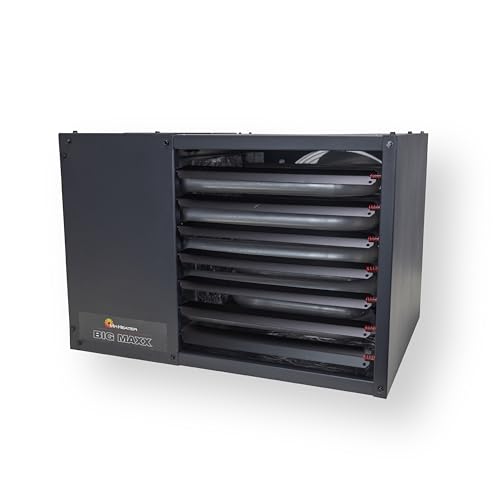
- Heats up to 2,667 square feet
- Ceiling-mounted forced-air design
- LP conversion kit included
Best For: Large garages, barns, and workshops
Best Portable Pick
VEVOR 60,000 BTU Propane Heater

- Portable 13.7-pound design
- 60,000 BTU output
- Overheat and flameout protection
Best For: Mobile garage, job-site, and outdoor heating
Best No-Electricity Option
Mr. Heater 30,000 BTU Radiant Heater

- 30,000 BTU radiant heat
- No electricity required
- Built-in thermostat and safety shut-off
Best For: Smaller indoor spaces without outdoor venting
Best Ceiling-Mounted Pick
Mr. Heater 50,000 BTU Forced-Air Unit Heater

- 50,000 BTUs cover up to 1,667 square feet
- Low-profile ceiling-mounted design
- Includes NG-to-LP conversion kit
Best For: Permanent installations in larger garages and workshops
Best Portable High-Output Pick
Mr. Heater 80,000 BTU Convection Heater
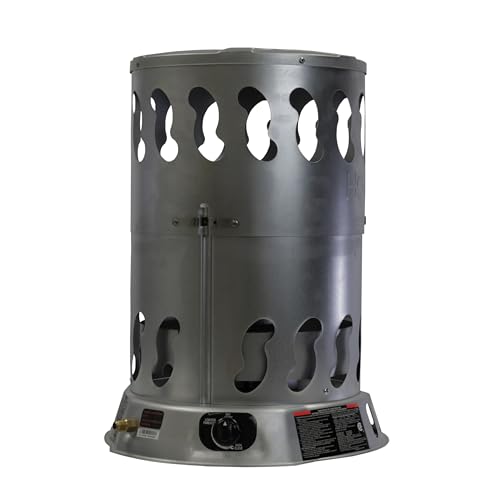
- 80,000- and 30,000-BTU heat settings
- Covers up to 2,000 square feet
- Portable design with hose and regulator
Best For: Ventilated spaces needing temporary, powerful heat
Best Compact Radiant Pick
Mr. Heater Original 45,000 BTU Tank Top Heater

- Mounts directly to a 20-pound propane tank
- Three heat settings up to 45,000 BTUs
- Lightweight with tip-over protection
Best For: Portable outdoor heating and open-air work areas
Best with Extra Features
Flame King 60,000 BTU Forced Air Heater

- 60,000 BTU output for up to 1,500 sq. ft.
- Includes hose and built-in regulator
- Multiple safety shutoff features
Best For: Large, open, well-ventilated garages and job sites
Best Tank-Top Value
XtremepowerUS 30,000 BTU Dual Burner Heater
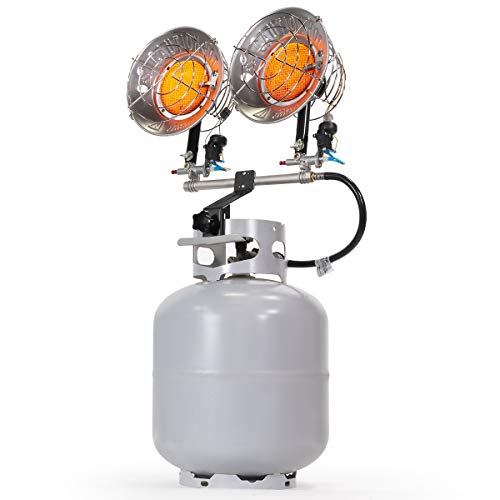
- Three settings up to 30,000 BTU
- Attaches directly to a 20-lb propane tank
- Tip-over gas shutoff included
Best For: Airy garages, workshops, and outdoor spot heating
Best Compact Indoor Option
Mr. Heater 9,000 BTU Portable Buddy
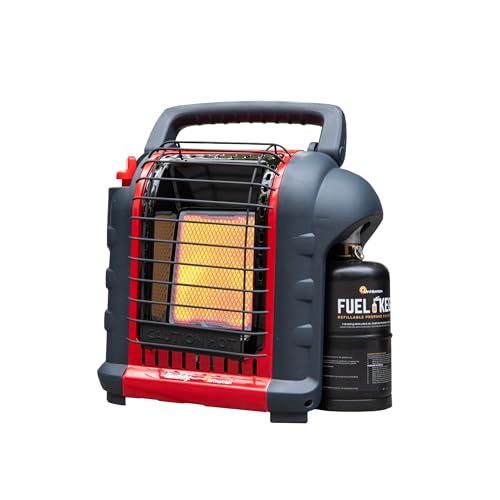
- 4,000- and 9,000-BTU heat settings
- Approved for indoor and outdoor use
- Low-oxygen safety system included
Best For: Small garages and portable localized heating
Best Ceiling-Mount Pick – Modine Hot Dawg HD45AS01-21
For a permanent propane garage heater setup, the Modine Hot Dawg combines ceiling mounting with direct-vent, forced-air heating. Its 45 kW output and stated 1,500-square-foot coverage make it a practical choice for enclosed garage workspaces.
Best For: Garage owners seeking a fixed, ceiling-mounted liquid propane heater for spaces up to 1,500 square feet.
Pros:
- Fueled by liquid propane.
- Direct-vent design is intended for indoor use.
- Ceiling mount keeps floor space available.
- Listed as noiseless, with 45 kW heat output.
Cons:
- At 60 pounds, installation may require substantial mounting support.
- Designed for a permanent setup rather than portable heating.
- Its 120-volt specification means an electrical connection is still required.
This is a strong fit when you want an organized, permanent heating solution instead of a floor-standing unit. Verify installation requirements and garage ventilation before use.
Best High-Output Option – Mr. Heater 80,000 BTU Unit Heater
This Mr. Heater unit is a high-capacity option among propane garage heaters, delivering 80,000 BTUs for areas up to 2,667 square feet. Its ceiling-mounted forced-air design is suited to garages, barns, and workshops with sufficient ceiling clearance.
Best For: Large garages and workshops that need powerful, thermostat-compatible ceiling heating.
Pros:
- 80,000 BTUs of output with stated coverage up to 2,667 square feet.
- Compatible with standard 24-volt and newer Wi-Fi-enabled thermostats, sold separately.
- Includes a natural-gas-to-LP conversion kit.
- High-temperature and flame-sensor safety shut-offs are included.
Cons:
- Requires a minimum 10-foot ceiling and 8 feet of clearance from heater base to floor.
- Thermostat is not included.
- Ceiling installation and its 78.2-pound weight make setup more involved.
With its large coverage rating and included LP conversion kit, this is the most suitable choice here for a spacious workspace. Confirm ceiling height, fuel configuration, and professional installation requirements before purchasing.
Best Portable Pick – VEVOR 60,000 BTU Propane Heater
The VEVOR 60,000 BTU heater offers a mobile alternative to fixed propane garage heaters. Its portable floor-mount design, carrying handle, electronic ignition, and adjustable heating angle make it useful for garages, job sites, and indoor or outdoor spaces.
Best For: Users who need movable propane heat for areas up to 1,400 square feet, including temporary garage or job-site work.
Pros:
- Portable 13.7-pound design with an ergonomic handle.
- 60,000 BTU output and stated coverage up to 1,400 square feet.
- Overheat and flameout protection systems are included.
- Works with a 20-pound propane tank and supports 7–11 hours of operation.
Cons:
- Floor-mounted and portable rather than a permanent installed heater.
- Temperature range is listed as 30°–45° for stepless adjustment.
- Requires a propane tank, hose, and regulator setup.
This model is convenient when heating needs change from one location to another. Its indoor/outdoor rating and protective features add flexibility, but use it according to the supplied operating requirements and safety guidance.
Best No-Electricity Option – Mr. Heater 30,000 BTU Radiant Heater
For smaller spaces, this vent-free radiant propane heater provides up to 30,000 BTUs without requiring electricity or outdoor venting. Its wall-mounted cabinet design and built-in thermostat make it a compact option for indoor heating.
Best For: Smaller indoor spaces needing wall-mounted radiant heat without an electrical connection.
Pros:
- 30,000 BTU output with stated heating coverage up to 1,000 square feet.
- No electricity or outdoor venting is required.
- Battery-operated electronic ignition includes a battery.
- Built-in adjustable thermostat and low-oxygen safety shut-off.
Cons:
- Wall mounting is less flexible than a portable heater.
- Blower fan kit is sold separately.
- Listed with a 4,500-foot high-altitude restriction.
This heater makes sense when simple installation and radiant warmth matter more than high-output forced air. Check the room size, mounting requirements, and altitude limitation before using it in a garage.
Best Ceiling-Mounted Pick – Mr. Heater 50,000 BTU Forced-Air Unit Heater
For shoppers comparing propane garage heaters, this Mr. Heater unit is a low-profile, ceiling-mounted option that can also run on natural gas. Its 50,000-BTU forced-air output is rated to heat up to 1,667 square feet, making it suited to larger garages, barns, and workshops.
Best For: Permanently installed garages or workshops with at least a 10-foot ceiling and suitable floor clearance.
Pros:
- 50,000 BTUs of forced-air heat for spaces up to 1,667 square feet.
- Ceiling-mounted, low-profile design keeps floor space available.
- Compatible with standard 24-volt and newer Wi-Fi-enabled thermostats, sold separately.
- Includes an NG-to-LP conversion kit for fuel flexibility.
Cons:
- Requires a minimum 10-foot ceiling and 8 feet of clearance from the heater base to the floor.
- Thermostat is sold separately.
- At 60.3 pounds, installation is less portable than floor-standing heaters.
This is the strongest fit when you want substantial, centrally mounted heat and have the ceiling height and installation setup it requires. Its safety shut-off switch and flame sensor add useful protection for a permanent garage-heating installation.
Best Portable High-Output Pick – Mr. Heater 80,000 BTU Convection Heater
Among propane garage heaters, this portable convection model stands out for high output and simple floor placement. It offers selectable 80,000- or 30,000-BTU settings, heats up to 2,000 square feet, and uses a cylindrical chamber for 360-degree heat distribution.
Best For: Well-ventilated garages, workshops, barns, warehouses, and temporary work areas where portable heat is useful.
Pros:
- High 80,000-BTU output with a lower 30,000-BTU setting.
- Rated to heat spaces up to 2,000 square feet.
- Portable 13.4-pound design with floor mounting.
- Includes a 10-foot hose, regulator, and built-in piezo lighter.
Cons:
- Designed for outdoor use and requires good ventilation.
- Uses a propane connection rather than natural gas.
- Convection heat may be less targeted than a mounted forced-air heater.
Choose this model when portability and maximum heat output matter more than a permanent installation. Its thermo-electric safety valve is designed to shut off gas flow if the flame goes out, but the heater should be used only in a properly ventilated setting.
Best Compact Radiant Pick – Mr. Heater Original 45,000 BTU Tank Top Heater
This tank-top model offers a compact approach to propane garage heaters, mounting directly to a 20-pound propane tank for easy portability. Its adjustable three-setting regulator delivers 30,000, 36,000, or 45,000 BTUs, while the multi-directional radiant burner provides targeted outdoor heat.
Best For: Outdoor work areas and other open-air applications where direct, portable radiant heat is preferred.
Pros:
- Mounts directly to a standard 20-pound propane tank.
- Three heat settings from 30,000 to 45,000 BTUs.
- Adjustable tilt head and 360-degree burner support directional heating.
- Lightweight 5.6-pound heater with tip-over safety shut-off.
Cons:
- For outdoor use only, so it is not suitable for enclosed garage heating.
- Requires a compatible 20-pound propane tank.
- Radiant output is rated for approximately 1,125 square feet.
This is the most portable and compact option in the group, especially for outdoor tasks or open-sided work areas. Its outdoor-only rating is the key limitation: do not select it as an enclosed-garage heater.
Best with Extra Features – Flame King 60,000 BTU Forced Air Heater
For large, open, well-ventilated garages, this Flame King is one of the most powerful propane garage heaters in the roundup. Its forced-air design delivers 60,000 BTU and is listed for spaces up to 1,500 square feet, while the included hose and regulator simplify setup with a propane tank.
Best For: Large, well-ventilated garages, job sites, patios, and other open areas needing fast, high-output heat.
Pros:
- Powerful 60,000-BTU output for coverage up to 1,500 square feet.
- Includes an LP hose with built-in regulator and uses a 120-volt wall plug.
- Built-in fuel shutoff, fire detection, and tilt shutoff safety features.
- Auto Piezo ignition and a gas control button support convenient operation.
Cons:
- Requires adequate airflow and is intended for outdoor or open, well-ventilated spaces.
- A 20-pound propane bottle is sold separately.
- Indoor storage and propane disconnection are required for safe storage.
Choose this model when rapid heating and broad coverage matter most. Its ventilation requirements make it better suited to an open garage than an enclosed room, but the high output and included regulator make it a practical jobsite-style option.
Best Tank-Top Value – XtremepowerUS 30,000 BTU Dual Burner Heater
This XtremepowerUS tank-top heater offers a compact way to add propane heat in airy garages, workshops, and outdoor work areas. Its dual-burner design reaches up to 30,000 BTU, mounts directly to a 20-pound propane cylinder, and provides three heat settings.
Best For: Airy garages, workshops, construction areas, and outdoor activities where directional tank-top heat is useful.
Pros:
- Adjustable output with three settings from 15,000 to 30,000 BTU.
- Mounts directly to a 20-pound propane cylinder without assembly.
- Tip-over switch shuts off the gas flow if the heater is knocked over.
- Rust-resistant steel frame and emitter guard offer a sturdy design.
Cons:
- Propane cylinder is not included.
- Designed for airy areas and outdoor use rather than sealed indoor spaces.
- Manual match lighting may be less convenient than push-button ignition.
This is a straightforward choice for spot heating near a workbench or activity area. The tank-top format keeps it portable and the three settings add flexibility, but ventilation and careful placement remain important.
Best Compact Indoor Option – Mr. Heater 9,000 BTU Portable Buddy
The Mr. Heater Portable Buddy is a compact radiant model for smaller spaces, making it a practical choice among propane garage heaters when you need modest, portable warmth. It offers 4,000- or 9,000-BTU settings and is designed and approved for indoor and outdoor use, with coverage of approximately 225 square feet.
Best For: Small garages, workshops, homes, patios, and portable heating in spaces up to approximately 225 square feet.
Pros:
- Indoor- and outdoor-approved design with compact portable construction.
- Two heat settings deliver 4,000 or 9,000 BTU per hour.
- Emergency low-oxygen safety system adds an important protective feature.
- Runs up to 5.4 hours on low with a 1-pound propane cylinder.
Cons:
- Its approximately 225-square-foot coverage is limited for larger garages.
- A 1-pound propane cylinder lasts about 2.4 hours on high.
- Unauthorized accessories or attachments can cause injury and void the warranty.
For a small garage or a user who values portability, the Portable Buddy is an easy-to-manage option. Its output is substantially lower than larger forced-air and tank-top heaters, so it is best reserved for localized heating rather than warming a large workspace.
How We Picked These Propane Garage Heaters
We selected heaters that represent the main ways to heat a garage or workshop with propane: permanently installed vented units, high-output forced-air heaters, quiet radiant models, and compact portable options. We considered heating capacity, portability, ignition and control features, fuel flexibility, construction, and practical safety systems such as tip-over protection, automatic shutoff, and overheat protection.
Because garages vary widely in insulation, ceiling height, door openings, and local installation requirements, no single heater is right for every user. Treat listed BTU output as a starting point rather than a guarantee of real-world room temperature.
Quick Comparison
| Heater type | Best suited for | Main advantage | Key limitation |
|---|---|---|---|
| Vented unit heater | Regularly used garages and workshops | Permanent, efficient heating | Requires installation and venting |
| Forced-air heater | Large, drafty, or partly open spaces | Fast high-output heat | Fan noise and airflow |
| Radiant heater | Spot heating and occupied work areas | Direct, quiet warmth | Limited whole-room circulation |
| Portable or tank-top heater | Temporary work, outdoor use, or emergencies | Easy setup and mobility | More exposed fuel and ventilation concerns |
Key Buying Factors for Propane Garage Heaters
BTU Output and Garage Size
Small insulated garages may need only a compact radiant heater, while large workshops, tall ceilings, and frequently opened doors require substantially more output. Oversizing can waste fuel and create uncomfortable hot spots; undersizing may leave the space cold and encourage continuous operation.
Venting and Indoor-Air Requirements
Direct-vent and other vented heaters send combustion gases outside and are generally better suited to permanent indoor installation. Vent-free and portable combustion heaters require careful adherence to the manufacturer’s ventilation rules and local codes. Never use a fuel-burning heater in an enclosed space unless the product is specifically approved for that application.
Heat Distribution and Noise
Forced-air models warm a larger area quickly but use a fan and can be noisy. Radiant heaters are quieter and effective for warming people or workstations directly, though they may not heat an entire garage evenly.
Fuel, Power, and Portability
Check whether the heater supports propane only or can also run on natural gas. Portable forced-air models commonly need electricity for the fan, while some radiant heaters operate without a household electrical connection. Confirm hose, regulator, cylinder, and outlet requirements before buying.
Safety and Operating Conditions
Look for automatic shutoff systems, tip-over protection, stable bases, overheat protection, and clear clearance requirements. Keep combustibles away from the heater, use a carbon monoxide alarm where appropriate, and follow the manual every time.
Who Should Buy Which Propane Garage Heaters?
Choose a vented Modine-style unit if you use the garage frequently and want a permanent heating solution. A Mr. Heater or similar forced-air model is a better match for large, drafty spaces that need fast heat, especially during short work sessions. Radiant and tank-top models make sense when you want quiet spot heating near a bench, vehicle, or outdoor work area. Compact portable heaters are useful for occasional tasks, but they are not a substitute for properly sized whole-garage heating.
Before purchasing, measure the space, review insulation and ventilation, identify the nearest propane supply, and confirm local installation rules. The safest choice is the model whose output and installation requirements fit your garage—not simply the heater with the highest BTU rating.