A head-up display can make everyday driving easier by putting speed, engine data, and selected alerts closer to your natural line of sight. The best option depends on your car’s compatibility, the information you want to see, and how much installation you are willing to handle.
We compared 10 popular car HUDs, including simple GPS speedometers and feature-rich OBD2 units, to help you choose a practical display for commuting, road trips, and routine city driving.
Best 10 Car Head Up Displays for Daily Driving Picks for 2026
Best Plug-and-Play Pick

- USB-powered without an OBD port
- Large display with auto brightness
- 10Hz GPS/BDS speed tracking
Best For: Simple daily speed monitoring in USB-equipped vehicles
Best Large-Screen Option

- Large 5.5-inch color display
- Shows multiple vehicle measurements
- Auto/manual brightness and unit switching
Best For: Compatible OBD II vehicles needing broader driving data
Best Data-Tracking Pick

- Combines OBD2 and GPS modes
- Includes fault-code scanning features
- Customizable speed and vehicle alarms
Best For: Compatible vehicles needing gauges and basic diagnostics
OBD2 Insight
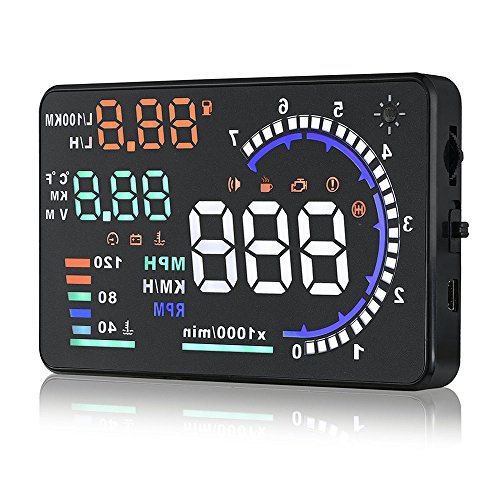
- Displays speed plus RPM, temperature, voltage, and mileage
- Plug-and-play for compatible OBD2 gasoline vehicles
- Includes overspeed alerts and adjustable brightness
Best For: Drivers wanting windshield-projected vehicle diagnostics
GPS Simplicity

- GPS/BDS speed tracking with a 10Hz refresh rate
- USB-powered with MPH/KM/H switching
- Large display, calibration, brightness control, and overspeed alert
Best For: Drivers wanting an easy GPS speed display without OBD installation
Automatic Clarity

- USB-powered and compatible with most vehicles with a USB port
- Automatic brightness adjusts for day and night driving
- Large MPH display with GPS/BDS positioning and 10Hz refresh
Best For: Drivers seeking a compact, broadly compatible GPS HUD
Simple Speed Visibility

- Large white LED speed display
- 6.6-foot USB cable and plug-and-play setup
- Automatic on/off with included mounting accessories
Best For: Drivers seeking a basic, easy-to-read speed HUD
Signal-Smart Driving Aid

- GPS+BDS reception with 10 Hz refresh
- MPH/KM/H switching and manual calibration
- Brightness control and customizable overspeed alert
Best For: Drivers wanting adjustable GPS speed data and alerts
Data-Rich OBD Companion
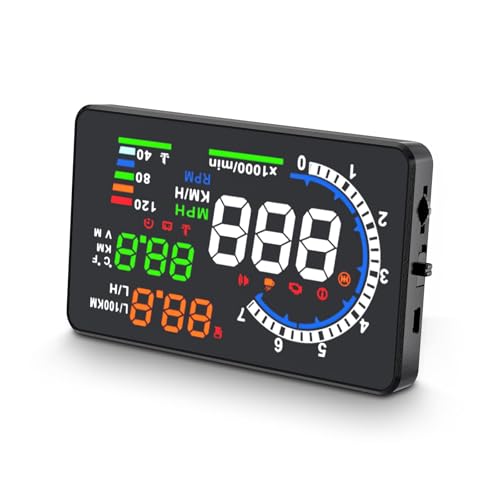
- 5.5-inch HD multifunction display
- Shows speed, RPM, temperature, voltage, and more
- Supports OBDII/EOBD vehicle data and diagnostic functions
Best For: OBDII/EOBD drivers wanting broad vehicle information
Best Plug-and-Play Pick – USB GPS Car HUD
For drivers comparing car head up displays for daily driving, this compact USB-powered GPS model focuses on clear speed projection without requiring an OBD port. Its large display, automatic brightness adjustment, and 10Hz GPS/BDS positioning make it a straightforward option for everyday vehicles with USB power.
Best For: Drivers who want a simple, USB-powered speed display with large numbers and automatic brightness.
Pros:
- Uses GPS and BDS with a 10Hz refresh rate and support for up to 32 satellites.
- Automatic brightness adjustment helps visibility in daytime and nighttime conditions.
- Large, anti-reflective speed display is designed to be easy to read.
- Works with most cars, trucks, and motorcycles that have a USB port.
Cons:
- GPS speed can vary by approximately 0.6–1.8 MPH.
- Signal may be affected in tunnels, underground garages, heavy rain, fog, or vehicles with metallic windshield film.
- Displays speed rather than the broader vehicle data available from OBD-based units.
This is a practical choice when installation simplicity matters most. It avoids vehicle-specific OBD compatibility questions, though GPS limitations mean it may be less consistent in obstructed signal conditions.
Best Large-Screen Option – 5.5-Inch OBD II HUD
This 5.5-inch OBD II model is worth considering among car head up displays for daily driving if you want more than projected speed. It can show vehicle information such as water temperature, battery voltage, fuel consumption, and mileage while offering automatic or manual brightness control.
Best For: Drivers with compatible OBD II or EUOBD vehicles who prefer a larger, multifunction display.
Pros:
- Large 5.5-inch color screen uses nanometer technology to help reduce reflections.
- Displays speed, water temperature, battery voltage, fuel consumption, and mileage.
- Supports automatic or manual brightness adjustment and MPH/KMH switching.
- Automatically powers on and off with the vehicle.
Cons:
- Compatibility is limited to OBD II or EUOBD vehicles, with stated production-year requirements.
- Professional installation is recommended.
- Its larger screen and OBD connection may require more installation consideration than a USB GPS unit.
The large screen and vehicle-data coverage make this a strong fit for owners of compatible cars. Confirm your vehicle’s OBD II or EUOBD compatibility before buying, especially if you want all listed functions to work.
Best Data-Tracking Pick – OBD2 and GPS Dual-System HUD
For drivers seeking information beyond speed, this dual-system unit stands out among car head up displays for daily driving. It combines OBD2 vehicle data with GPS functions, supports customizable alerts, and can scan or clear engine fault codes on supported vehicles.
Best For: OBDII-compatible drivers who want driving gauges, warning thresholds, and basic fault-code functions in one display.
Pros:
- Displays speed, RPM, fuel consumption, water temperature, voltage, altitude, and other data through OBD2.
- Can scan and clear fault codes and read real-time data streams on supported vehicles.
- Offers GPS fallback functions if the vehicle’s OBD2 protocol is incompatible.
- Includes adjustable overspeed, temperature, voltage, and RPM alarms.
Cons:
- Vehicle compatibility is restricted; listed exclusions include diesel, hybrid, RV, modified-computer vehicles, and several brands.
- Only compatible with OBDII/EOBD vehicles produced after 2008, and it does not support OBD I or JOBD.
- GPS mode provides fewer vehicle-specific readings than OBD2 mode.
This is the most feature-rich choice in the group for compatible vehicles, particularly if diagnostics and configurable alerts matter. Compatibility should be checked carefully because the extensive OBD2 functions depend on the vehicle protocol.
Best Customizable GPS Pick – Adjustable-Speed Car HUD
This USB GPS model adds calibration, unit switching, and overspeed alerts to the essentials, making it a flexible option among car head up displays for daily driving. It provides a large speed readout while letting drivers adjust brightness and tailor the display to their preferred MPH or KM/H format.
Best For: Drivers who want a simple GPS speed display with speed calibration and an overspeed warning.
Pros:
- Uses GPS and BDS with a 10Hz refresh rate and support for up to 32 satellites.
- USB plug-and-play power simplifies installation.
- Supports MPH/KMH switching and manual speed calibration.
- Offers adjustable brightness and a customizable overspeed alert.
Cons:
- GPS reception may be temporarily affected in tunnels, garages, poor weather, or by metallic windshield film.
- It is primarily a speed-focused display rather than a multifunction OBD gauge.
- Speed calibration requires user adjustment if the displayed reading needs matching to the vehicle dashboard.
Choose this model if you value straightforward installation but want more control than a basic GPS speedometer provides. Its calibration and overspeed alert are useful daily-driving additions, while signal conditions remain an important consideration.
OBD2 Insight – A8 Vehicle Data HUD
For drivers looking at car head up displays for daily driving, the A8 is a practical choice when your vehicle has a compatible OBD2 port. It projects speed, RPM, water temperature, voltage, and mileage onto the windshield, helping reduce the need to glance down at the dashboard.
Best For: Drivers who want vehicle diagnostics and speed information in one windshield display.
Pros:
- Shows speed, RPM, water temperature, voltage, and mileage.
- Plug-and-play setup for compatible OBD II/EUOBD gasoline vehicles.
- Includes overspeed alerts, automatic brightness adjustment, and automatic power-on/off.
- Nano-technology display and reflective film support clear projection.
Cons:
- Compatibility is limited; it does not work with several listed Dodge, Jeep, Mazda, Suzuki, French, Italian, Hyundai, and Kia vehicles.
- Requires an OBD2-compatible gasoline vehicle rather than USB-only power.
The A8 offers more vehicle data than a basic GPS speed display, but compatibility should be confirmed before purchase. It is especially useful for owners who want engine-related readings alongside speed.
GPS Simplicity – K4 Green Speed HUD
The K4 is a straightforward option for car head up displays for daily driving, using GPS and BDS positioning instead of an OBD connection. Its USB-powered design, large speed readout, and selectable MPH or KM/H display make it easy to install and use across many vehicles.
Best For: Drivers seeking a simple GPS speed display with flexible units and manual calibration.
Pros:
- Uses dual-mode GPS and BDS with a 10Hz refresh rate and support for up to 32 satellites.
- USB plug-and-play power works without an OBD port.
- Offers MPH/KM/H switching, speed calibration, adjustable brightness, and overspeed alerts.
- Large font and anti-reflective shading improve readability.
Cons:
- GPS performance may be affected in tunnels, underground garages, heavy rain, fog, or behind metallic windshield film.
- It focuses on GPS speed rather than displaying engine data such as RPM or coolant temperature.
The K4 is a sensible daily-driving HUD when installation simplicity matters more than vehicle telemetry. Its calibration and unit-switching features add flexibility, while its GPS dependence is worth considering for enclosed or obstructed routes.
Automatic Clarity – K1 GPS Car HUD
For car head up displays for daily driving, the K1 emphasizes easy compatibility and hands-free readability. It uses USB power rather than an OBD port, projects GPS speed in a large format, and automatically adjusts brightness for changing light conditions.
Best For: Drivers who want a compact, USB-powered HUD for cars, trucks, or motorcycles.
Pros:
- Compatible with most vehicles equipped with a USB port, including cars, trucks, and motorcycles.
- Uses GPS and BDS positioning with a 10Hz refresh rate and up to 32 satellites.
- Automatic brightness adjustment helps manage daytime visibility and nighttime glare.
- Large MPH speed display with anti-reflective metal shading.
Cons:
- GPS readings can vary by approximately 0.6–1.8 MPH.
- Signal may be interrupted in tunnels, underground garages, poor weather, or vehicles with metallic windshield film.
- It provides speed information rather than OBD-based engine metrics.
The K1 is a good fit for drivers prioritizing broad vehicle compatibility and automatic display control. Its GPS-based operation keeps setup simple, though users should expect normal satellite-signal limitations and minor speed deviation.
Simple Speed Visibility – Large-Font USB GPS HUD
For drivers comparing car head up displays for daily driving, this plug-and-play unit focuses on the information most people need: current speed. Its large white LED numerals, windshield reflection film, and automatic power control are designed to make speed checks quick without looking down at the instrument cluster.
Best For: Drivers who want a straightforward, large-font speed display with flexible USB installation.
Pros:
- Displays real-time vehicle speed in a large, high-brightness format.
- Plug-and-play USB setup includes a long 6.6-foot cable for flexible placement.
- Automatic power on/off and included anti-slip pad, reflective film, and applicator simplify installation.
- Designed to work with most mainstream vehicle models.
Cons:
- Its feature set is focused on speed rather than broader vehicle data.
- The listed manufacturer warranty is 30 days from purchase.
This is a practical pick if you want a simple speed-only HUD rather than a more data-heavy display. The large numerals and included installation accessories make it especially appealing for daily commuting.
Signal-Smart Driving Aid – Dual-Mode GPS Speedometer HUD
Among car head up displays for daily driving, this model emphasizes GPS reception and adjustable driving information. Its dual-mode GPS+BDS chip, 10 Hz refresh rate, switchable units, brightness controls, calibration function, and overspeed alert give it more adjustment options than a basic speed display.
Best For: Drivers who want a compact GPS HUD with calibration, brightness adjustment, and customizable overspeed warnings.
Pros:
- Uses GPS+BDS reception, supports up to 32 satellite signals, and refreshes at 10 Hz.
- Switches between MPH and KM/H and supports manual speed calibration.
- Offers adjustable brightness and a customizable overspeed alert.
- USB plug-and-play power and a large anti-reflective display support quick installation and readability.
Cons:
- GPS performance may be temporarily affected in tunnels, underground garages, heavy rain or fog, and vehicles with metallic windshield film.
- It relies on USB 5V power rather than a more integrated vehicle connection.
This HUD is a strong fit when speed accuracy controls and alerts matter as much as basic visibility. Keep its GPS limitations in mind if your regular route includes tunnels or covered parking.
Data-Rich OBD Companion – wiiyii A8 Large-Screen HUD
For shoppers evaluating car head up displays for daily driving, the wiiyii A8 stands out as a multifunction OBDII/EOBD information display rather than a speed-only unit. Its 5.5-inch HD screen can show speed, RPM, water temperature, voltage, distance, and selected alerts, while its plug-and-play design reads information from the vehicle’s trip computer.
Best For: Drivers with an OBDII or EOBD vehicle who want speed plus broader vehicle monitoring in one display.
Pros:
- Large 5.5-inch HD display supports clearer viewing and multifunction switching.
- Shows speed, RPM, water temperature, voltage, distance, fuel consumption, and alarm prompts.
- Supports MPH/KM/H switching and includes voltage and speeding alerts.
- Can read vehicle data for failure detection, failure alerts, and failure clearing.
Cons:
- Only supports OBDII and EOBD vehicles; it does not support OBD I or JOBD.
- Its broader data display may be more than needed for drivers who only want speed.
- Compatibility depends on the vehicle’s supported diagnostic system and model year.
The A8 is the most information-focused option in this group. Confirm that your car uses OBDII or EOBD before buying, then consider it if you want a larger screen with multiple vehicle readings rather than a minimalist HUD.
How We Picked the Best Car Head Up Displays for Daily Driving
We focused on the features that matter during regular use: readable projection, reliable speed data, straightforward installation, useful warnings, and compatibility with different vehicles. The lineup includes GPS-based displays that work independently of the vehicle computer and OBD2 models that can show additional engine information.
We also considered whether a display offers automatic power control, adjustable brightness, multiple measurement units, and a layout that can be understood quickly without distracting from traffic. Product specifications and advertised functions should still be checked carefully before purchase, especially for older vehicles and models with unusual OBD2 access.
Quick Comparison
| HUD type | Best for | Typical information | Installation |
|---|---|---|---|
| GPS | Broad vehicle compatibility | Speed, direction, selected alerts | USB or power socket |
| OBD2 | Drivers wanting engine data | Speed, RPM, coolant temperature, voltage, fault alerts | OBD2 cable |
| Dual-system | Flexible data options | GPS speed plus vehicle readings | Power and OBD2 connection |
Key Buying Factors for Car Head-Up Displays for Daily Driving
Compatibility and Data Source
GPS HUDs are generally the safer choice when you want a simple speed display across multiple vehicles. OBD2 units can provide richer information, but they require a compatible diagnostic port and may not expose every advertised reading on every car.
Readability in Changing Light
Look for large digits, adjustable brightness, and a projection surface that remains visible in both daylight and darkness. A supplied reflective film can improve contrast, while excessive brightness may become distracting at night.
Useful Information Rather Than Clutter
For daily driving, speed, overspeed warnings, and automatic on/off are often more valuable than a crowded screen. If you want RPM, coolant temperature, battery voltage, or fuel-related data, verify that your vehicle supports those readings.
Power and Placement
Check whether the unit uses USB, a 12-volt socket, or an OBD2 connection. Position the display low enough to preserve forward visibility and secure loose cables so they do not interfere with pedals or controls.
Who Should Buy Which Car Head Up Displays for Daily Driving?
Choose a GPS model if you want plug-and-play installation, a straightforward speed readout, or a HUD that can move between vehicles. These are particularly practical for older cars or drivers who do not need engine metrics.
Choose an OBD2 model if your car has a compatible port and you want speed alongside RPM, coolant temperature, voltage, or diagnostic-related alerts. Confirm compatibility before relying on any specific gauge.
Choose a dual-system HUD if you want the flexibility of GPS speed data with the possibility of richer vehicle information. It can be a good compromise for commuters who want more than a basic speedometer without installing a permanent dashboard instrument.
Whichever type you select, treat the display as a convenience aid rather than a replacement for the vehicle’s original gauges or your attention to the road.