If you want an entry-level diagnostic tool that goes beyond the bare minimum, this OBD2 Scanner Diagnostic Tool is aimed squarely at that job.
It focuses on code reading, live vehicle data, battery checks, and quick reporting rather than app-dependent complexity.
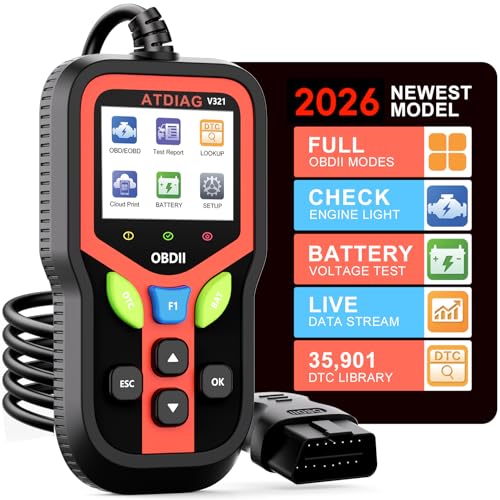
OBD2 Scanner Diagnostic Tool Review Summary
This OBD2 Scanner Diagnostic Tool makes sense for drivers, DIY mechanics, and small-shop users who want a straightforward handheld scanner with more depth than the cheapest code readers.
It is especially appealing if you want a plug-and-play device for reading and clearing trouble codes, checking readiness monitors, and looking at basic live data without relying on a phone app.
The strongest case for this OBD2 Scanner Diagnostic Tool review is its mix of practical functions and low-friction operation.
The listing emphasizes broad vehicle compatibility, multi-language support, a color display, a built-in code library, battery testing, EVAP testing, freeze frame access, and QR-based report printing.
That combination points to a tool built for fast diagnosis rather than casual novelty use.
What keeps it from being a universal recommendation is that this is still a category-specific scanner, not a full professional diagnostics platform.
Buyers should expect a useful handheld helper for common OBD2 jobs, but not assume it will replace brand-specific dealership tools or advanced bi-directional scan equipment.
Review Scorecard
| Category | Score | Why it scores this way |
|---|---|---|
| Code reading and clearing | 8/10 | Supports read/clear functions plus a code library that is larger than basic scanners. |
| Live diagnostic usefulness | 7/10 | Live sensor data and freeze frame are genuinely helpful for troubleshooting. |
| Ease of use | 8/10 | Plug-and-play design, clear manual, and shortcut keys reduce friction. |
| Vehicle compatibility | 8/10 | Works with most OBD2 vehicles from the stated model-year ranges. |
| Reporting and sharing | 7/10 | Cloud/QR printing is useful for saving or sharing results. |
| Durability and portability | 7/10 | Rugged case and insulated cable suggest practical real-world use. |
| Value for buyers | 8/10 | The feature set fits home mechanics who want more than a basic reader. |
Key Features and Specifications of OBD2 Scanner Diagnostic Tool
The product is a handheld OBD2 scanner for vehicles with a standard 16-pin OBD2 port.
The listing says it covers most cars manufactured after 1996 in the US, 2000 in Europe, and 2008 in Asia, so it is designed for a broad mainstream audience rather than a niche vehicle class.
Important advertised functions include reading and clearing trouble codes, checking I/M readiness, viewing real-time sensor data such as RPM, coolant temperature, and fuel pressure, running EVAP tests, checking battery health, and accessing freeze frame data.
The device also includes a built-in library decoding more than 35,901 fault codes, which is a meaningful step up from very basic readers that only give a terse code definition.
The hardware and usability details matter too:
- 2.4-inch color display
- Built-in shortcut keys for report access, DTC reading, and battery testing
- 10-language support, including English, Spanish, French, and Portuguese
- Tri-color indicator lights for quick status recognition
- Cloud/QR code printing for reports
- 3.0-foot insulated cable
- Rugged silicone case
- Claimed operating tolerance from -22°F to 158°F
The listing also presents it as ready to use out of the box.
That matters for buyers who do not want to pair an app, create an account, or manage another device ecosystem just to check a check-engine light.
Pros and Cons of OBD2 Scanner Diagnostic Tool
Pros
- Broad core coverage for the most common OBD2 tasks, including code reading, code clearing, readiness checks, freeze frame, and live data.
- Useful for diagnosis, not just code lookup, because the larger fault-code library and live sensor views add context.
- Easy to approach for beginners thanks to plug-and-play operation, shortcut keys, and a color screen.
- Good compatibility range for many US, EU, and Asia-market vehicles that follow OBD2 standards.
- Reporting features are practical if you want to save or share results after a driveway diagnosis.
- More durable than a toy scanner based on the rugged case, insulated cable, and temperature claims.
Cons
- Not positioned as a full professional scan tool, so advanced brand-specific functions are not the main story here.
- The listing language is broad, which means buyers should verify vehicle fit before assuming every function will work on every car.
- Battery testing and report printing are useful additions, but they do not replace deeper electrical or module-level diagnostics.
- Some buyers may prefer app-based tools, while this product is built around a handheld workflow.
Who Should Buy OBD2 Scanner Diagnostic Tool?
This is a sensible buy for drivers who want to understand a check-engine light before visiting a shop.
It also fits DIY owners who already know the basics of OBD2 and want a more capable handheld scanner than the simplest code readers.
It should also appeal to people who service multiple vehicles and value quick access to readiness status, freeze frame data, and live sensor readings.
The multi-language support broadens its use case for households or shops where English is not the only working language.
You should probably skip it if you need OEM-level diagnostics, active component testing, or a tablet-style scan platform with deeper system control.
If your work depends on advanced manufacturer functions, this looks more like a strong general-purpose scanner than a specialist shop tool.
OBD2 Scanner Diagnostic Tool Diagnostics and Workflow
Read Codes Fast
The core value here is speed.
Plug it in, pull the fault code, and you have a much better idea of whether the issue is minor, urgent, or something that needs more investigation.
For everyday owners, that alone can justify the tool.
Use Live Data Wisely
Live sensor data is where this scanner becomes more than a basic reader.
RPM, coolant temperature, and fuel pressure readings help you see whether a problem is intermittent, sensor-related, or tied to operating conditions rather than a one-time stored code.
Check Battery and EVAP Basics
Battery testing and EVAP testing are useful because they cover two common trouble areas that often confuse non-professionals.
The point is not to replace a full electrical diagnostic setup, but to provide enough information to narrow the problem before spending money on parts.
Save and Share Reports
The cloud/QR printing feature is a practical touch for buyers who keep maintenance records or want to pass information to a mechanic.
That kind of documentation is more valuable than it sounds, especially when a code returns after a reset.
Alternatives to OBD2 Scanner Diagnostic Tool
If you want a comparable handheld reader, consider a BlueDriver Bluetooth Pro OBD2 Scan Tool for a phone-connected approach with a different workflow.
Another common option is an Autel OBD2 scanner, which is useful if you want to compare portable scanners across a broader brand family.
For buyers who want a simple all-around code reader, a ANCEL OBD2 scanner is also worth looking at because it often sits in the same practical DIY category.
If you prefer a more established handheld format, an INNOVA scan tool may be a better fit, especially for users who want a familiar standalone device.
Is OBD2 Scanner Diagnostic Tool Worth It?
Yes, if you want a straightforward handheld OBD2 scanner with enough depth to be genuinely useful.
The feature set is strong for the price tier this kind of product usually occupies: code reading, code clearing, freeze frame, live data, battery checks, EVAP testing, a larger fault-code library, and a readable screen.
The main reason to buy it is practical ownership convenience.
It gives home mechanics and everyday drivers a faster way to understand what is happening before they visit a repair shop or replace parts blindly.
The main reason to pass is if you need advanced, brand-specific diagnostic control rather than broad OBD2 coverage.
For most DIY buyers, this looks worth considering as a capable everyday scanner, not as a replacement for professional-grade equipment.