Working on an engine in a low garage or near-floor workspace requires more than a high weight rating. The right stand must provide enough clearance, roll smoothly, and keep the engine secure while you rotate or reposition it.
We selected 10 engine stands across several capacities and designs, including compact three- and four-caster models, heavy-duty foldable frames, and rotating stands for different engine sizes and workspace constraints.
Best 10 Engine Stands for Low Cars Picks for 2026
Best Adjustable Low-Car Stand
VEVOR 750-Lb Adjustable Engine Stand

- 750-lb high-strength steel capacity
- Adjustable width and length
- Four swivel casters and ratchet straps
Best For: DIY mechanics needing flexible engine support
Best Rotating Low-Car Engine Stand

- 1250-lb load capacity
- Rotates for assembly and disassembly
- Ball-bearing swivel casters
Best For: Heavy-duty engine rebuilding and workshop use
Best Locking Low-Car Engine Stand

- 360-degree adjustable mounting head
- Stable H-shaped base
- One braked caster for positioning
Best For: Controlled rotating engine repair
Best Heavy-Duty Low-Car Stand
LOCKIETTA 2000-Lb Foldable Engine Stand

- 2000-lb high-strength steel capacity
- 360-degree rotating head
- Folds quickly for compact storage
Best For: Heavier engines and demanding repair work
Heavy-Duty Pick
Pro 1000lb Rotating Engine Stand

- 1,000-pound steel capacity
- 360-degree rotating head
- Adjustable arms and swivel casters
Best For: High-capacity engine work and frequent repositioning
Compact Shop Choice
JEGS 750lb Rotating Engine Stand
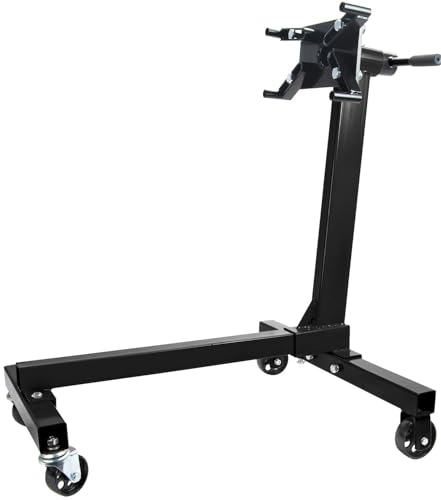
- 750-pound capacity
- 360-degree adjustable mounting head
- Disassembles for storage
Best For: Moderate-capacity garage engine projects
Maximum Capacity Option

- 1,000-pound capacity
- Rotating engine access
- Disassembles for storage
Best For: Heavy engine projects needing a robust rotating stand
Best with Extra Features

- Supports up to 2,000 pounds
- 360-degree swivel head
- Six casters and foldable base
Best For: Heavy engines and space-conscious home garages
Best Balanced Option
VEVOR 1500-Lb Folding Engine Stand

- 1,500-pound tested capacity
- Five casters with four brakes
- Folds to 14.8 inches wide
Best For: DIY garages needing mobility and compact storage
Best Budget-Size Choice

- 750-pound load capacity
- Four adjustable mounting arms
- Wide base and powder-coated steel
Best For: Smaller engines and routine DIY vehicle repairs
Best Adjustable Low-Car Stand – VEVOR 750-Lb Adjustable Engine Stand
For engine stands for low cars, the VEVOR adjustable stand is a practical choice when you need flexible positioning and a compact working height. Its movable mounting posts, adjustable width and length, and included ratchet straps help support a range of engines during maintenance.
Best For: DIY mechanics who need adjustable fitment and easy engine movement.
Pros:
- Supports up to 750 pounds with Q235B high-strength steel construction.
- Adjustable width and length accommodate various engine types.
- Four 3-inch swivel casters and two ratchet straps aid positioning and stability.
Cons:
- The casters have no brakes.
- Its 750-pound capacity may not suit heavier engine assemblies.
This VEVOR model emphasizes adjustability and mobility, making it useful where a low-car workspace calls for flexible engine placement. Verify the engine’s mounting points and weight before buying.
Best Rotating Low-Car Engine Stand – JEGS 1250-Lb Engine Stand
Among engine stands for low cars, the JEGS 1250-lb model is suited to hands-on assembly and disassembly work where rotating the engine is important. Its heavy-gauge square steel construction, ball-bearing casters, and disassembly design support both workshop use and storage.
Best For: Engine assembly, disassembly, and mechanics who need broad load capacity.
Pros:
- 1250-pound capacity provides substantial load support.
- Engine rotates to different positions for low- and top-end work.
- Ball-bearing swivel casters make it easier to move around the work area.
Cons:
- At 63.4 pounds, it is relatively heavy to relocate.
- The supplied notes do not specify adjustable mounting width or length.
The JEGS stand is a strong option when rotation and capacity matter more than extensive fitment adjustment. Its easy-disassembly design is also useful if workshop storage space is limited.
Best Locking Low-Car Engine Stand – VEVOR 750-Lb Rotating Stand
For engine stands for low cars, this VEVOR rotating stand combines a 360-degree adjustable head with a stable H-shaped base. Four adjustable arms, secure hex-head bolts, and a braked caster make it a practical option for controlled engine repair positioning.
Best For: Mechanics who want rotating access with a lockable, mobile base.
Pros:
- 750-pound tested capacity with an H-shaped base for added stability.
- 360-degree rotating mounting arms provide access around the engine.
- Two fixed wheels and two universal wheels, including one braked caster, support movement and positioning.
Cons:
- Its 750-pound capacity is lower than the 1250- and 2000-pound options in this roundup.
- The cast-iron body and 41.4-pound weight may make handling less convenient than lighter stands.
This model balances rotation, mobility, and a more secure parked position. The extended handle and six location holes further help with engine positioning during repair work.
Best Heavy-Duty Low-Car Stand – LOCKIETTA 2000-Lb Foldable Engine Stand
For engine stands for low cars, the LOCKIETTA foldable stand stands out for its 2000-pound capacity and 360-degree rotating mount. Its H-shaped base, four adjustable arms, six universal wheels, and quick-folding design target demanding repair work where strength and storage flexibility are priorities.
Best For: Professional or DIY users handling heavier engines and limited storage space.
Pros:
- High-strength steel frame supports up to 2000 pounds.
- 360-degree rotating head and four adjustable arms improve access and fitment.
- Folds quickly and uses six universal wheels for workshop mobility.
Cons:
- The supplied notes do not identify a wheel brake.
- Its heavy-duty design may be more capacity than needed for lighter engines.
- Exact assembled dimensions are not provided in the notes.
This is the capacity-focused choice in the group, with useful rotation and storage features alongside its heavy-duty frame. Confirm available floor space and engine compatibility before purchase.
Heavy-Duty Pick – Pro 1000lb Rotating Engine Stand
If you need engine stands for low cars, this 1,000-pound steel model offers a sturdy, maneuverable setup for raising, transporting, and working on engines. Its 360-degree rotating head and adjustable mounting arms provide access to multiple sides of an engine during assembly or service.
Best For: DIY mechanics and shops needing high capacity, rotating access, and easy repositioning.
Pros:
- Supports engine blocks up to 1,000 pounds.
- 360-degree rotating mounting head improves access to engine components.
- Four adjustable arms accommodate engine mounting points.
- Heavy-duty swivel casters and a wide base aid movement and stability.
Cons:
- Heavier than the listed 750-pound alternative at 21 kg.
- Its larger overall footprint may require more storage space.
This is the strongest-capacity option in the group, with a practical combination of rotation, adjustable mounting, and mobility. Consider it when engine weight and stable positioning matter most.
Compact Shop Choice – JEGS 750lb Rotating Engine Stand
For engine stands for low cars where moderate capacity and easy handling are priorities, this JEGS stand provides a 750-pound rating with a 360-degree adjustable mounting head. Its mixed caster arrangement supports movement around the work area, while the frame disassembles for storage or transport.
Best For: Home garages and lighter engine projects that need rotating access without a 1,000-pound capacity.
Pros:
- Rotates an engine for low- and top-end assembly or disassembly.
- Heavy-gauge square steel tube construction.
- Two swivel and two fixed wheels help move the stand.
- Disassembles for storage or transport.
Cons:
- 750-pound capacity is lower than the two 1,000-pound options.
- Only two of the four wheels are swivel casters.
This model is a practical middle-ground choice for users who want rotational access and straightforward mobility while staying below the capacity of heavier-duty stands.
Maximum Capacity Option – JEGS 1000lb Rotating Stand
Among engine stands for low cars, this JEGS model is suited to heavier projects requiring a 1,000-pound capacity and rotating access. The heavy-gauge square-tube frame uses ball-bearing casters for movement and can be disassembled when the stand needs to be stored.
Best For: Mechanics handling heavier engines who want a rotating stand with a storage-friendly design.
Pros:
- Supports up to 1,000 pounds.
- Rotates the engine for low- and top-end work.
- Ball-bearing swivel casters help move the stand around the workspace.
- Disassembles for storage when not in use.
Cons:
- Listed weight of 82 pounds makes it substantially heavier than the 750-pound JEGS model.
- Its higher capacity may be unnecessary for lighter engines.
Choose this stand when capacity is more important than minimizing the stand’s own weight. It combines the requested heavy-duty rating with rotation, caster-based mobility, and convenient disassembly.
Best with Extra Features – Foldable 2000-Lb Engine Stand
For shoppers comparing engine stands for low cars, this foldable steel model combines a 2,000-pound capacity with a 360-degree swivel head. Its adjustable mounting arms and six casters make it a versatile option for garage engine work, while the folding H-base helps conserve storage space.
Best For: Home garages handling heavy engines and needing a foldable, highly mobile stand.
Pros:
- Supports engines up to 2,000 pounds.
- 360-degree rotating head provides access from multiple angles.
- Four adjustable mounting arms fit various engine sizes and bolt patterns.
- Six casters and a foldable H-base improve mobility and storage.
Cons:
- Its heavy-duty capacity may be more than needed for smaller engines.
- The notes do not specify the folded dimensions.
This is the strongest-capacity choice in the group and a practical fit when stability, broad compatibility, and compact storage all matter for garage repairs.
Best Balanced Option – VEVOR 1500-Lb Folding Engine Stand
For engine stands for low cars, the VEVOR 1500-pound model offers a useful balance of load capacity, maneuverability, and storage convenience. Its rotating head, locking casters, and folding design suit garages where you need to position an engine precisely without permanently giving up floor space.
Best For: DIY mechanics who want a sturdy, mobile stand with brakes and compact folded storage.
Pros:
- Tested capacity of up to 1,500 pounds.
- 360-degree rotating mounting arms support flexible engine access.
- Five universal casters include four brakes for positioning control.
- Folds to 14.8 inches wide for easier storage.
Cons:
- Its 1,500-pound capacity is lower than the 2,000-pound model in this roundup.
- At 62.2 pounds, it is a substantial piece of shop equipment to move manually.
With alloy-steel construction, rust-protective coating, and locking casters, this VEVOR stand is a well-rounded choice for controlled engine work in a busy or compact garage.
Best Budget-Size Choice – Big RED 750-Lb Rotating Stand
Among engine stands for low cars, the Big RED AT23401BR is a lighter-capacity option for vehicle maintenance and auto repair. It uses a heavy-duty steel frame, four adjustable arms, and a 360-degree rotating head to hold many domestic and foreign engine blocks while remaining easier to maneuver than larger stands.
Best For: Smaller vehicle engines and DIY users who need a straightforward rotating stand with a 750-pound limit.
Pros:
- 750-pound load capacity suits many car, SUV, truck, and van applications.
- Four adjustable arms and a 360-degree head improve engine access.
- Wide base supports stability during maintenance.
- Powder-coated steel helps resist rust and includes a one-year limited warranty.
Cons:
- 750-pound capacity is substantially lower than the other two options.
- Uses three casters, including one swivel caster, rather than six or five wheels.
- The stand does not list a folding storage feature.
This Big RED stand makes sense when your engine falls within its 750-pound limit and you prefer a simpler, lighter-duty setup for routine vehicle repair work.
How We Picked the Best Engine Stands for Low Cars
We focused on the features that matter most when an engine stand is used around low vehicles, compact garages, and limited-access work areas. Our comparison considers rated capacity, frame stability, wheel layout, swivel-head design, adjustability, storage, and the practical clearance needed to position an engine safely.
Capacity ratings are useful starting points, but they do not tell the whole story. A stand should comfortably exceed the weight of the engine and accessories being supported. We also favored designs that make it easier to control rotation and move the load without excessive rocking.
Quick Comparison
- Best for compact workspaces: A lower-profile stand with three or four casters can be easier to position around a low car.
- Best for heavier engines: Choose a 1,000- to 2,000-pound-rated frame, while still checking the manufacturer’s actual operating instructions.
- Best for frequent rebuilding: A 360-degree rotating head and adjustable mounting arms improve access to the block.
- Best for storage: A foldable model can save valuable floor space between projects.
Key Buying Factors for Engine Stands for Low Cars
Overall Height and Clearance
Measure the distance from the floor to the lowest part of the vehicle or work area, then compare it with the stand’s frame, casters, and mounting head. A stand that is technically strong but too tall may be difficult to use near a low car. Also allow room for the engine, oil pan, accessories, and lifting equipment.
Capacity and Balance
Select a rating well above the complete engine assembly’s weight. Account for intake components, exhaust parts, transmission adapters, fluids, and temporary accessories. A broad base and properly distributed mounting arms help prevent tipping as the engine rotates.
Casters and Maneuverability
Four or more casters generally provide smoother support, while three-caster designs may turn easily in tight spaces. Look for sturdy wheels and locking features, and use the stand only on a level, solid surface. Small casters can struggle over cracks, thresholds, or uneven concrete.
Rotating Head and Mounting Hardware
A 360-degree head is valuable for underside access, but rotation should be controlled and locked securely before work begins. Confirm that the mounting arms and included hardware fit the engine block’s bolt pattern; adapters may be necessary for some applications.
Who Should Buy Which Engine Stands for Low Cars?
Choose a 750-pound stand for smaller engines, routine maintenance, and users who prioritize a compact footprint. A 1,000- to 1,500-pound model is a sensible middle ground for many automotive and light-truck projects. Pick a 2,000-pound foldable stand for heavier assemblies or frequent shop use, provided its larger frame fits your available clearance.
Before buying, verify the stand’s dimensions, folded size, caster construction, head-locking method, and warranty. Never exceed the rated capacity, and secure the engine at multiple mounting points before rotating or moving it.