Car amplifiers with DSP combine amplification and sound tuning in one package, making them a smart upgrade for clearer, more controlled in-car audio.
Whether you want simple plug-and-tune convenience or advanced crossover and EQ control, this roundup focuses on the best options for different systems and budgets.
Best 10 Car Amplifiers with Dsp Picks for 2026
Flagship 6-Channel DSP Powerhouse
AudioControl D-6.1200 1200W 6-Channel DSP Amp

- 6-channel amp configurable to 5-, 4-, or 3-channel modes
- Speaker-level, RCA, and assignable preamp connectivity
- 30-band graphic EQ plus 10-band parametric EQ per output
Best For: Full-system builds and factory integration
All-in-One Media DSP Amp
Stetsom HL DSPlayer 400x4 with BT, App and FM

- Built-in DSP with EQ, phase, delay, and crossover control
- RCA, optical, USB, wire inputs, and Bluetooth support
- Includes FM radio and processed output for an auxiliary amp
Best For: All-in-one installs with media playback and app tuning
Compact DSP Crossover Tool
Taramps PRO 2.4S 4-Channel Digital Crossover

- 15-band graphic EQ plus parametric EQ
- RCA and high-level inputs for OEM or aftermarket systems
- Active crossover, delay alignment, limiter, and Anti-Pop System
Best For: Dedicated DSP tuning in custom or OEM upgrades
8-Channel DSP Output Amp
JBL DSP4086 40W x 8 Car Amplifier

- 8 channels with 60W RMS x 8 at 2 ohms
- 6 assignable and summable inputs
- Time alignment, crossover filters, and 32-band EQ
Best For: Multi-speaker systems needing flexible DSP control
App-Controlled DSP
Taramps PRO 2.4 BT DSP Processor
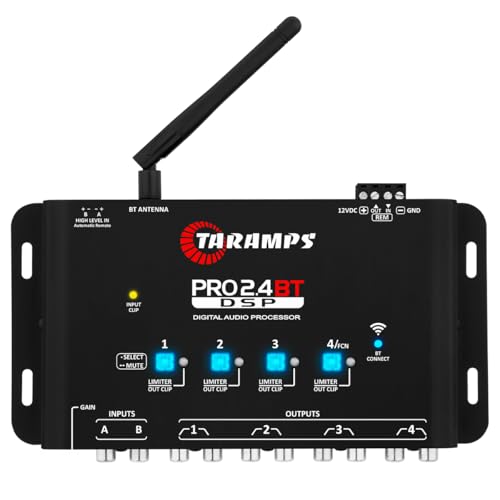
- Bluetooth 5.4 app control for real-time tuning
- 15-band EQ, parametric EQ, and crossover tools
- High-level input with auto turn-on for factory systems
Best For: DIY tuners and factory integrations that need deep DSP control
Power DSP Amp
AudioControl D-4.800 4-Channel DSP Amp

- Up to 800W with 4/3/2-channel flexibility
- 30-band graphic EQ plus 10-band parametric EQ
- Speaker-level and RCA inputs for OEM or aftermarket use
Best For: Drivers who want a high-power DSP amp with advanced tuning
High-Power Multi-Channel DSP Amp
AudioControl EPICSIX 6-Channel 1200W

- 6-channel Class D amp with 1200W RMS output
- Flexible setups: 3-way, 5-channel, 6-channel, or bridged
- Built-in crossovers and smart protection
Best For: Flexible high-output aftermarket systems
Ultra-Thin Android DSP Amp

- Mini ultra-thin aluminum shell
- Universal DSP communication interface
- RCA output boosts low-frequency signal
Best For: Slim Android-system integration and quick installs
Flagship 6-Channel DSP Powerhouse – AudioControl D-6.1200 1200W 6-Channel DSP Amp
If you want car amplifiers with dsp that can do serious system integration, the AudioControl D-6.1200 is built for flexible OEM and aftermarket setups. It can run as a 6-, 5-, 4-, or 3-channel amp, includes speaker-level and RCA inputs, and gives you extensive tuning control through its DSP tools.
Best For: Full-system builds that need flexible channel routing, factory integration, and detailed tuning control.
Pros:
- Configurable as a 6-, 5-, 4-, or 3-channel amplifier
- 8 speaker-level inputs, 6 balanced RCA inputs, and 2 assignable preamp outputs
- 30-band graphic EQ plus 10-band parametric EQ per output channel
- Includes selectable crossovers, AccuBASS, and built-in diagnostics
Cons:
- More complex than a basic amp-only upgrade
- Designed for users who will take advantage of its DSP features
This model stands out if you need one unit to handle power, routing, and fine tuning in a single package. It is especially appealing for factory system upgrades where signal correction and control matter as much as output.
All-in-One Media DSP Amp – Stetsom HL DSPlayer 400×4 with BT, App and FM
For buyers comparing car amplifiers with dsp and wanting extra source options, this Stetsom model combines amplification, processing, Bluetooth, app control, and FM radio in one unit. Its built-in DSP provides adjustable EQ, level, phase, delay, and crossover settings, while the multiple inputs make it easier to connect different source types.
Best For: Drivers who want an all-in-one amp with built-in media features and DSP control.
Pros:
- Built-in DSP with EQ, level, phase, delay, and crossover adjustments
- Multiple inputs including RCA, wire inputs, optical audio, USB, and Bluetooth
- Dedicated mobile app for control and tuning
- Includes FM radio and processed output for an auxiliary amplifier
Cons:
- Only 4-channel output compared with larger multi-channel amps
- Smartphone not included
This is a practical choice when you want amplification and media playback features without adding separate components. It fits best in systems that value convenience and straightforward DSP adjustment.
Compact DSP Crossover Tool – Taramps PRO 2.4S 4-Channel Digital Crossover
If you’re shopping car amplifiers with dsp for tuning rather than raw power, the Taramps PRO 2.4S is a compact digital crossover and equalizer built for system setup. It offers flexible integration with RCA and high-level inputs, plus crossover, delay, limiter, and EQ tools for dialing in an OEM or custom build.
Best For: Installers and enthusiasts who want a dedicated DSP processor for precise tuning.
Pros:
- 15-band graphic EQ plus parametric EQ for detailed tuning
- Active crossover, delay alignment, and limiter controls
- RCA and high-level inputs for OEM or aftermarket integration
- Anti-Pop System helps reduce turn-on and turn-off noises
Cons:
- Not an amplifier, so it does not provide speaker power on its own
- Best suited to users building a system around separate amps
This processor is a strong fit when your priority is clean signal management and exact frequency control. It makes the most sense as the tuning brain in a more advanced audio setup.
8-Channel DSP Output Amp – JBL DSP4086 40W x 8 Car Amplifier
The JBL DSP4086 is a compact option for shoppers looking at car amplifiers with dsp and wanting lots of channel flexibility. It provides eight channels of output, assignable and summable inputs, time alignment, crossover filters, and a 32-band EQ for system tuning.
Best For: Multi-speaker systems that need flexible DSP control in a compact amplifier.
Pros:
- 8-channel output with 60 watts RMS x 8 at 2 ohms
- 6 assignable and summable inputs for flexible routing
- Time alignment, crossover filters, and 32-band EQ
- Compact surface-mount design
Cons:
- Lower per-channel power than larger high-output amps
- Designed more for control and channel count than big output numbers
For systems that need many channels and fine DSP control, this JBL is a practical fit. It favors tuning flexibility and integration over maximum power output.
Auto-Tuning Upgrade – Kicker Key 4-Channel DSP Smart Amp
If you want car amplifiers with dsp that focus on clarity instead of just volume, the Kicker KEY 47KEY2004 is built for fast factory-system upgrades. Its internal computer, microphone-based tuning, 40-band EQ, and 24 dB crossover are aimed at making stock speakers sound cleaner, louder, and more balanced with minimal setup.
Best For: Drivers upgrading a factory stereo who want a compact, automatic DSP amp with quick tuning.
Pros:
- Auto-tuning processor uses the included microphone to optimize sound in minutes.
- 40-band equalizer and 24 dB crossover give strong control over tone and speaker behavior.
- Compact 4-channel design is easy to mount for a straightforward install.
- Designed to reveal clearer, more realistic sound from factory speakers.
Cons:
- Rated at 4 x 50W, so it is not aimed at high-output aftermarket builds.
- Best results depend on using the auto-tuning process correctly.
Overall, this is a smart pick if you want an easier DSP upgrade for an OEM system and care more about refinement than raw power.
App-Controlled DSP – Taramps PRO 2.4 BT DSP Processor
Among car amplifiers with dsp accessories and tuning tools, the Taramps PRO 2.4 BT is a flexible digital signal processor for drivers who want hands-on control from an app. It brings Bluetooth 5.4 BLE tuning, 15-band graphic EQ, parametric EQ, crossover filters, delay, phase inversion, and limiter tools to help shape and protect a system.
Best For: Custom audio builds and factory integrations that need deep DSP control from a phone or tablet.
Pros:
- Bluetooth app control lets you adjust settings in real time from iOS or Android.
- High-level input with auto turn-on makes it easier to integrate with factory head units.
- Up to 9V RCA input support and 2-in/4-out routing give it broad flexibility.
- Includes practical tuning tools like EQ, crossovers, delay, phase, and limiter control.
Cons:
- It is a processor, so it is not a standalone power amplifier.
- Its advanced feature set may be more than casual users need.
This is a strong choice when you want serious tuning control, modern app-based adjustment, and broad compatibility across different car audio setups.
Power DSP Amp – AudioControl D-4.800 4-Channel DSP Amp
If you are shopping car amplifiers with dsp and want both processing control and meaningful output, the AudioControl D-4.800 is built for flexible system integration. It offers up to 800W, a configurable 4/3/2-channel layout, input and output RTAs, selectable crossovers, a 30-band graphic EQ, and a 10-band parametric EQ per output channel.
Best For: OEM or aftermarket systems that need a high-power DSP amplifier with detailed tuning options.
Pros:
- Up to 800W output with 4-channel, 3-channel, or 2-channel configuration options.
- Built-in DSP tools include selectable crossovers, filters, EQ, and AccuBASS restoration.
- Multiple input options, including speaker-level and RCA, support factory and aftermarket installs.
- DM Smart App control gives clear access to setup and tuning.
Cons:
- Bigger and heavier than compact DSP amps at 16 x 12 x 5 inches and 5 pounds.
- Its broad feature set may take more time to configure than simpler plug-and-play units.
For buyers who want a true DSP amplifier with strong output and deep system control, this AudioControl model stands out as a serious all-in-one upgrade.
Compact DSP Tuner Amp – Eonon A304 16-Pin Car DSP Amplifier 4x50W
If you want a straightforward car amplifiers with dsp upgrade, the Eonon A304 is built around simple plug-and-play installation and easy onboard tuning. It combines a dedicated automotive DSP chip with a Class D amp, giving you adjustable bass, treble, volume, and preset EQ options without adding much bulk.
Best For: Drivers who want a compact, easy-to-install DSP amplifier with basic sound-shaping controls.
Pros:
- 4-channel Class D design with up to 4 x 50W max output
- Adjustable bass, treble, volume, and 6 EQ presets
- Standard 16-pin connector supports direct plug-and-play setup on compatible stereos
- Includes remote control, onboard knob, and voice prompts
Cons:
- Compatibility depends on your stereo’s interface
- Best suited to users who only need moderate power
This is a practical choice if you value simplicity, compact size, and easy sound customization over a highly complex install. The aluminum alloy heat sink also adds reassurance for stable use during longer listening sessions.
High-Power Multi-Channel DSP Amp – AudioControl EPICSIX 6-Channel 1200W
For shoppers comparing car amplifiers with dsp in a more powerful full-range setup, the AudioControl EPICSIX stands out for its flexible channel layouts and robust output. It supports active 3-way, 5-channel, active 6-channel, or bridged configurations, while built-in crossovers and protection features help it fit into a serious aftermarket system.
Best For: Enthusiasts building a flexible, high-output aftermarket audio system.
Pros:
- 6-channel digital Class D design with 1200W RMS output
- Configurable as 3-way, 5-channel, 6-channel, or bridged setup
- 12dB/octave Linkwitz-Riley crossovers for frequency control
- Smart protection helps guard against voltage, short-circuit, and thermal issues
Cons:
- Direct wire terminals require more involved installation than plug-and-play units
- Fuse is recommended separately
This amplifier makes the most sense if you want serious output and configuration options rather than a quick upgrade. Its compact low-profile chassis also helps it fit where larger multi-channel amps may not.
Ultra-Thin Android DSP Amp – 4-Channel 80W x 4 Full-Range
If you need car amplifiers with dsp for an Android-based factory or navigation system, this 4-channel full-range unit is aimed at simplifying the upgrade. Its ultra-thin aluminum-shell design is meant to install quickly, while the universal DSP communication interface is designed to connect to the original car audio system and media player.
Best For: Android car player owners who want a slim DSP amplifier with easy integration.
Pros:
- Mini ultra-thin aluminum design for quick installation
- Universal DSP communication interface for simpler connectivity
- 4-channel 80W x 4 full-range output
- Additional RCA output to support stronger low-frequency signal to active subwoofers
Cons:
- Product notes focus on compatibility, so system fit should be verified first
- Less feature-rich than larger multi-channel DSP amplifiers
Overall, this is a focused upgrade for drivers who want better power and bass support without a bulky amplifier. Its value is in the slim form factor and the DSP-friendly interface rather than advanced tuning controls.
How We Picked the Best Car Amplifiers with Dsp
We focused on models that balance power, tuning flexibility, and real-world ease of installation. The best Car Amplifiers with Dsp should do more than add watts; they should help shape the sound with useful EQ, crossover, and signal-management features. We also looked for options with practical inputs, strong channel counts, and control methods that suit both beginners and experienced installers.
Quick Comparison
Some units are built as compact all-in-one solutions for simple upgrades, while others are better suited to more advanced systems that need higher output and finer tuning. If you want the easiest path, look for integrated app control or built-in DSP presets. If you want maximum system flexibility, prioritize models with more channels, higher-voltage inputs, and robust crossover options.
Key Buying Factors for Car Amplifiers with Dsp
Channel Count and Speaker Layout
Match the amplifier to your system design. A 4-channel model is often enough for front and rear speakers, while 6- or 8-channel options make more sense for active front stages, sub integration, or more complex builds.
DSP Features and Tuning Depth
Look for EQ bands, crossover control, time alignment, and input/output management. Basic DSP can improve clarity, but deeper tuning tools are better if you want to correct cabin issues or tailor the sound precisely.
Power Output and Headroom
Make sure the amplifier provides enough clean power for your speakers. More headroom usually means less distortion at higher volume, especially in larger vehicles or systems with inefficient speakers.
Inputs, Compatibility, and Control
Check RCA and high-level input support if you are keeping a factory head unit. App control can make tuning easier, while certain systems may benefit from OEM integration features or external control options.
Who Should Buy Which Car Amplifiers with Dsp?
If you want a simple, polished upgrade, choose a compact all-in-one amplifier with straightforward DSP control. If you are building a more serious audio system, step up to higher-channel AudioControl or JBL-style options with stronger tuning tools and more output. If you are budget-conscious, Taramps and similar DSP equalizer units can be a practical entry point, especially when you already have the rest of the system planned. For factory-radio upgrades or easy integration, look for models designed to work cleanly with OEM sources and mixed input types.
In short, the best choice depends on how much tuning control you want, how many speakers you need to power, and whether your priority is simplicity, flexibility, or maximum sound quality.