Choosing the right automotive oscilloscope can turn guesswork into a clear diagnostic path. Whether you’re tracing sensor signals, checking ignition events, or verifying communication lines, the right tool saves time and reduces repeat comebacks.
Below, we’ve narrowed the field to 10 options that balance bandwidth, channel count, portability, and automotive-friendly features so you can match the scope to your workflow and budget.
Best 10 Automotive Oscilloscope Picks for 2026
Premium Portable Pick
Micsig SATO1004 4-Channel Android Scope

- 4 channels, 100 MHz bandwidth, 1 GSa/s sampling
- Android system with physical buttons and touch control
- 32 GB storage plus Wi-Fi, LAN, HDMI, USB, Type-C
Best For: Technicians who want a portable 4-channel automotive scope with wireless and touchscreen convenience.
Best All-in-One Tool
FNIRSI 2C53T Scope Multimeter Generator

- 3-in-1 tool: scope, multimeter, and DDS signal generator
- 50 MHz bandwidth with 250 MSa/s sampling
- 19,999-count meter and waveform storage/export
Best For: Buyers who want a compact multi-tool for automotive repair and electronic testing.
Learning Resource Pick
Automotive Oscilloscopes Waveform Analysis
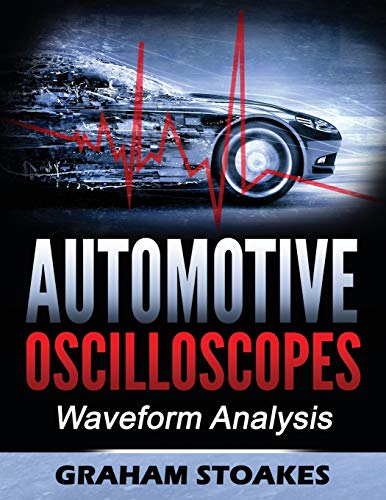
- Explains oscilloscope setup and use for vehicle diagnostics
- Covers waveform interpretation and common patterns
- Includes practical tips for troubleshooting
Best For: Technicians and students who want to build confidence in automotive waveform analysis.
PC Diagnostic Scope
Hantek 1008C Automotive Oscilloscope

- 8 channels with 12-bit resolution
- 80+ automotive diagnostic functions
- Programmable signal generator included
Best For: Windows users needing a PC-based automotive diagnostic oscilloscope
Portable Touchscreen Scope
FNIRSI 1013D Plus 100MHz Oscilloscope

- 100MHz dual-channel scope
- 7-inch touchscreen with gesture control
- Built-in battery and waveform storage
Best For: Portable general-purpose scope users who want touchscreen convenience
Multimeter-Scope Combo
AUTOOL DM302 Automotive Oscilloscope Kit
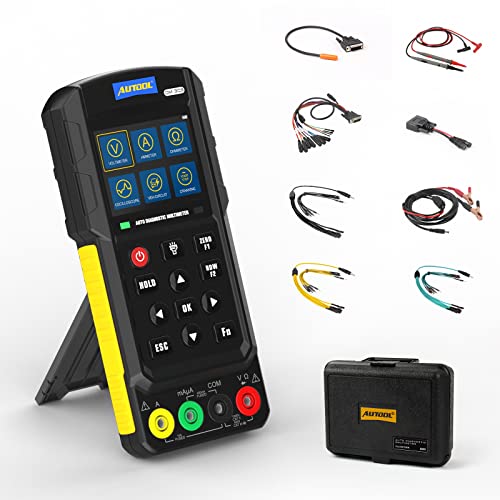
- TRMS multimeter plus 500KHz scope
- Tests CAN bus, K line, ignition, and sensors
- Includes wiring leads and probes
Best For: Hands-on automotive diagnostics in a single handheld kit
Compact Touchscreen Diagnostic Scope
FNIRSI 2C53P 3-in-1 50MHz Scope

- 2-channel 50MHz oscilloscope with 250MS/s sampling
- 19999-count multimeter and 10MHz DDS generator
- 4.3-inch IPS touchscreen with one-key AUTO
Best For: portable all-in-one diagnostics and quick field checks
Flexible Dual-Mode Handheld Scope
ZT-703S 3-in-1 Dual Channel 50MHz

- Dual-channel scope with AUTO recognition
- Switchable normal and high-speed modes up to 50MHz
- 25000-count multimeter plus signal generator
Best For: users who want a flexible handheld tester with selectable performance modes
High-Bandwidth Diagnostic Scope
FNIRSI 2D15P 100MHz 3-in-1 Scope

- 100MHz bandwidth with 500MS/s sampling
- 13 parameters, 6 math functions, and up to 1M memory depth
- 5000mAh battery with Type-C charging
Best For: demanding diagnostics needing higher bandwidth and deeper waveform analysis
Premium Portable Pick – Micsig SATO1004 4-Channel Android Scope
If you want an automotive oscilloscope that feels more like a modern tablet than a traditional bench tool, the Micsig SATO1004 stands out. It combines 4 channels, 100 MHz bandwidth, and automotive-focused diagnostic software, making it well suited to faster troubleshooting on ignition, sensors, networks, charging circuits, and pressure tests.
Best For: Technicians who want a portable 4-channel automotive scope with wireless and touchscreen convenience.
Pros:
- 4 channels with 100 MHz bandwidth and 1 GSa/s sampling for broader diagnostic coverage
- Android-based interface with added physical buttons and smoother touch operation
- Supports automotive tests including CAN, LIN, FlexRay, K, ignition, starter, and pressure diagnostics
- 32 GB internal storage plus Wi-Fi, LAN, HDMI, USB, and Type-C connections
Cons:
- More feature-rich than a basic handheld scope, so it may be more than some users need
- Wi-Fi remote viewing depends on a stable network environment
The SATO1004 is a strong choice if you value flexibility, storage, and a wide automotive feature set in one handheld package. Its mix of modern connectivity and dedicated diagnostic support makes it especially practical for everyday vehicle electrical work.
Best All-in-One Tool – FNIRSI 2C53T Scope Multimeter Generator
The FNIRSI 2C53T is a practical automotive oscilloscope if you want one handheld device to handle several testing jobs. It combines a 2-channel 50 MHz scope, a 19,999-count multimeter, and a DDS signal generator, which can be useful for diagnostics, quick verification, and general electrical troubleshooting.
Best For: Buyers who want a compact multi-tool for automotive repair and electronic testing.
Pros:
- 3-in-1 design with oscilloscope, multimeter, and signal generator functions
- 50 MHz bandwidth and 250 MSa/s sampling for handheld diagnostic work
- 19999-count multimeter mode covers voltage, current, resistance, capacitance, and continuity
- Built-in battery, Type-C charging, and waveform storage/export support
Cons:
- 2 channels only, so it is less flexible than 4-channel automotive scopes
- 2.8-inch display is smaller than tablet-style alternatives
This model makes sense when portability and versatility matter more than advanced scope depth. For routine automotive electronics checks, it offers a useful balance of features without requiring separate tools.
Learning Resource Pick – Automotive Oscilloscopes Waveform Analysis
Buying an automotive oscilloscope is only half the job; knowing how to read waveforms is what makes it valuable. This book focuses on setup, use, and waveform interpretation for automotive diagnosis, with straightforward guidance aimed at helping you get more from a scope in real-world vehicle testing.
Best For: Technicians and students who want to build confidence in automotive waveform analysis.
Pros:
- Covers oscilloscope setup and use in a practical automotive context
- Explains waveform patterns and interpretation for common vehicle systems
- Includes diagnostic tips and electrical principles to support troubleshooting
- Written for straightforward, uncomplicated use rather than rigid procedures
Cons:
- Not a physical diagnostic tool, so it does not replace hardware
- Best value depends on whether you need training more than equipment
If you already own a scope or are planning to buy one, this title can help you use it more effectively. It is a solid companion resource for turning oscilloscope readings into better diagnostic decisions.
Budget Combo Pick – FNIRSI 2C23T Handheld Scope Meter
The FNIRSI 2C23T is a compact automotive oscilloscope for users who want a basic handheld tool with extra measuring functions. Its 2-channel 10 MHz scope, 10,000-count multimeter, and signal generator make it a practical option for light automotive and DIY electronic testing.
Best For: Budget-conscious users who need a simple handheld scope for basic automotive checks.
Pros:
- 3-in-1 design with oscilloscope, multimeter, and signal generator functions
- 2-channel, 10 MHz bandwidth scope with 50 MSa/s sampling
- 10,000-count multimeter mode covers common electrical measurements
- Built-in rechargeable battery and waveform save/export support
Cons:
- 10 MHz bandwidth is lower than more advanced handheld automotive scopes
- 2.8-inch screen keeps the interface compact rather than spacious
This model is best viewed as a practical entry point rather than a high-end diagnostic scope. For users who want the basics in one portable device, it offers a useful feature set at a simpler level.
PC Diagnostic Scope – Hantek 1008C Automotive Oscilloscope
If you want an automotive oscilloscope that doubles as a practical PC-based diagnostic tool, the Hantek 1008C is built around flexibility. It combines 8-channel scope capabilities with automotive test functions and a programmable signal generator, making it useful for learning and for routine circuit troubleshooting on vehicles and other electronics.
Best For: Technicians, hobbyists, and electricians who want a Windows-based multi-channel oscilloscope with built-in automotive diagnostics.
Pros:
- 8 analogue channels with 12-bit resolution and 2.4MSa/s real-time sampling.
- More than 80 automotive diagnostic functions for ignition, sensors, bus detection, actuators, starting, and charging.
- Programmable signal generator can simulate crankshaft and camshaft signals.
- 20 automatic measurement modes help speed up signal reading and comparison.
Cons:
- USB PC software is Windows only.
- Requires a computer for operation rather than being a standalone handheld scope.
- Real-time sampling rate is modest compared with higher-end bench scopes.
Overall, the Hantek 1008C stands out as a budget-friendly diagnostic platform if you value channel count and automotive-specific functions more than portability. It is especially appealing for users who want one tool for basic scope work, signal simulation, and common car-system checks.
Portable Touchscreen Scope – FNIRSI 1013D Plus 100MHz Oscilloscope
The FNIRSI 1013D Plus is a portable oscilloscope for buyers who want a compact display, touchscreen control, and broad general-purpose measurement capability. While it is not a dedicated automotive oscilloscope, its 100MHz dual-channel design, fast sampling, and built-in battery make it a versatile option for bench work and on-the-go signal checks.
Best For: Users who want a portable dual-channel oscilloscope with touchscreen controls and battery power.
Pros:
- 100MHz dual-channel bandwidth with 1 GSA/S sampling rate.
- 7-inch touchscreen with gesture control and complete trigger modes.
- Built-in 6000mAh battery for about 4 hours of use.
- Includes waveform storage, Lissajous display, and FFT viewing.
Cons:
- Not designed specifically for automotive diagnostic functions.
- Only 2 channels, which may limit some vehicle testing workflows.
- Battery life is useful but not especially long for extended field sessions.
For shoppers comparing an automotive oscilloscope against a general portable scope, the FNIRSI 1013D Plus makes the strongest case on convenience and screen-driven usability. It is a good fit when portability matters more than car-specific test features.
Multimeter-Scope Combo – AUTOOL DM302 Automotive Oscilloscope Kit
The AUTOOL DM302 is a hybrid automotive oscilloscope and TRMS multimeter kit for users who want one handheld tool to handle more than waveform testing. It covers a wide measurement range, adds oscilloscope functions for common vehicle signals, and includes wiring leads for tasks like K line, CAN bus, ignition pulse, relay, and sensor checks.
Best For: Mechanics and DIY users who want a multimeter and automotive oscilloscope in one kit.
Pros:
- Combines TRMS multimeter functions with a 500KHz oscilloscope bandwidth.
- Measures automotive-related signals such as K line, CAN bus, ignition, camshaft, crankshaft, and wheel speed sensors.
- Includes multiple wiring lines and probes for battery, injector, relay, ECU, and ignition testing.
- True RMS, auto range, color screen, and flashlight add everyday usability.
Cons:
- 500KHz scope bandwidth is more limited than dedicated higher-speed oscilloscopes.
- 2.8-inch screen is relatively small.
- Best suited to common automotive diagnosis rather than advanced scope analysis.
As an automotive oscilloscope kit, the AUTOOL DM302 is most appealing when you want measurement convenience and vehicle-specific test leads in a single portable package. Its strengths are practical field diagnostics, not high-end scope performance.
Compact Touchscreen Diagnostic Scope – FNIRSI 2C53P 3-in-1 50MHz Scope
If you want an automotive oscilloscope that also handles everyday electrical checks, the FNIRSI 2C53P is built around portability and convenience. It combines a 2-channel 50MHz scope, a 19999-count multimeter, and a DDS signal generator in a compact handheld body, with a 4.3-inch IPS touchscreen and one-key AUTO to speed up routine testing.
Best For: Technicians who want a compact all-in-one tool for fast field diagnostics and signal checks.
Pros:
- 2-channel oscilloscope with 250MS/s sampling and 50MHz bandwidth
- 19999-count multimeter with max/min display for practical measurement work
- 4.3-inch IPS touchscreen plus one-key AUTO for simpler operation
- Built-in 4000mAh battery and Type-C charging for portable use
Cons:
- 4-hour battery life may be limiting for long sessions away from power
- Maximum signal generator output is 10MHz, which may not suit every test need
- Best suited to general diagnostics rather than bench-style full-size workflows
Overall, the 2C53P is a practical choice if you value a lightweight automotive oscilloscope with scope, meter, and generator functions in one unit. Its touchscreen interface and quick-auto features make it appealing for faster troubleshooting.
Flexible Dual-Mode Handheld Scope – ZT-703S 3-in-1 Dual Channel 50MHz
The ZT-703S is an automotive oscilloscope designed for users who want flexible measurement modes in a handheld package. It offers dual-channel scope testing, a 25000-count multimeter, and a signal generator, with AUTO recognition to help identify unknown waveforms more efficiently.
Best For: Users who need a flexible handheld tester with switchable performance modes for varied jobs.
Pros:
- Dual-channel oscilloscope with AUTO recognition for pulse, circular, noise, and other waveforms
- Two scope modes: 200MSa/s up to 30MHz in normal mode, or 280MSa/s up to 50MHz in high-speed mode
- 25000-count multimeter covering resistance, capacitance, continuity, diodes, and current
- Type-C charging and data transfer for simpler everyday use
Cons:
- User manual is important to read before use because of the device’s multiple functions
- Normal mode reduces bandwidth to 30MHz, so performance depends on the selected mode
- Battery life is not specified in the supplied notes
This model stands out if you want a handheld automotive oscilloscope with more operating flexibility than a basic fixed-mode unit. The selectable speed modes and signal generator add room for both troubleshooting and demonstration work.
High-Bandwidth Diagnostic Scope – FNIRSI 2D15P 100MHz 3-in-1 Scope
For buyers looking for a more capable automotive oscilloscope, the FNIRSI 2D15P brings higher bandwidth and deeper capture options into a portable 3-in-1 design. It pairs a 100MHz scope and 500MS/s sampling with a 19,999-count TRMS multimeter and a 10MHz DDS generator, while the 4.3-inch IPS touchscreen keeps operation straightforward.
Best For: More demanding diagnostics that benefit from higher bandwidth, deeper memory, and richer waveform analysis.
Pros:
- 100MHz bandwidth and 500MS/s sampling for faster signal capture
- 13 parameters, 6 math functions, and dedicated Single/Auto trigger for analysis
- Multiple memory depths up to 1M plus waveform save/export support
- 5000mAh battery and Type-C charging for longer field sessions
Cons:
- More advanced analysis features may be more than casual users need
- Heavier than compact handheld options at 907 g
- Signal generator output is limited to 10MHz
The 2D15P is the strongest pick here if your priority is a handheld automotive oscilloscope with more measurement depth and better capture performance. It balances portable use with the tools needed for more serious troubleshooting.
How We Picked These Automotive Oscilloscopes
We focused on the features that matter most in real vehicle diagnostics: usable bandwidth, sampling performance, channel flexibility, ease of setup, and whether the unit is practical in a bay, roadside, or mobile service environment. We also prioritized models that support common automotive tasks such as injector, crank/cam, ignition, sensor, and CAN-related testing.
For a roundup like this, the best Automotive Oscilloscope is not always the highest-bandwidth model. It’s the one that gives you clear captures, stable triggering, and a workflow that fits the jobs you actually perform.
Quick Comparison
Think of these choices in three broad groups. Handheld scopes are best for fast field use and tight spaces. PC-based USB units often offer more channels and stronger expansion for deeper analysis. Multi-function 3-in-1 models are attractive when you want an oscilloscope, multimeter, and signal generator in one compact package.
If you mainly need quick checks and portability, handheld units are often the easiest fit. If your work involves more advanced waveform comparison or multiple signals at once, a multi-channel or PC-connected setup may be the smarter purchase.
Key Buying Factors for an Automotive Oscilloscope
Bandwidth and Sample Rate
Bandwidth should match the signals you plan to measure. Basic sensor work can be handled by modest bandwidth, while ignition and faster waveform analysis benefit from more headroom. Sample rate matters just as much because it affects how accurately the scope captures transients and details in the waveform.
Channel Count
Two channels are enough for many common tests, but four or more can speed up comparison work, especially when correlating crank, cam, injector, and ignition signals. Multi-channel units are also useful for diagnostics on newer vehicles with more complex systems.
Portability and Power
A handheld Automotive Oscilloscope is ideal when you need to move around the vehicle, work in the driveway, or avoid a laptop. PC-based scopes may offer more flexibility and screen space, but they depend on the computer setup and cabling.
Automotive-Specific Extras
Look for features that reduce setup time, such as preset auto tests, built-in battery power, probe kits, CAN or K-line support, and solid measurement tools. A good display, reliable triggering, and clear menus often matter more than flashy specs.
Who Should Buy Which Automotive Oscilloscope?
Buy a handheld model if you want fast, simple diagnostics and maximum mobility. Choose a 3-in-1 unit if you want an affordable all-rounder for everyday electrical testing and signal generation. Pick a USB or multi-channel scope if you need deeper waveform comparison, more simultaneous inputs, or a more lab-style workflow.
For most buyers, the best choice comes down to how often you test, how complex the vehicles are, and whether you value portability or advanced analysis more. Match the scope to your diagnostic style, and you’ll get far better results than chasing the biggest spec sheet.