Choosing a trailer brake controller can feel complicated when you are new to towing. The right model helps your trailer brake smoothly, reduces stopping strain, and gives you better control in changing road conditions.
This roundup compares 10 options for different trailer sizes, vehicle setups, and budgets, including simple time-delay controllers and more responsive proportional designs.
Best 10 Trailer Brake Controller for Beginners Picks for 2026
Simple Time-Delay Pick

- Time-delay braking for light-duty towing
- LED output and connection diagnostics
- Supports 1-2 axles with 2 or 4 brakes
Best For: Beginners seeking simple, light-duty trailer braking
Proportional Value Option
90160 Trailer Brake Controller

- Proportional braking responds to vehicle braking intensity
- Digital display includes connection information
- Supports 1-3 axles and up to 6 brakes
Best For: Beginners wanting proportional braking and diagnostics
Low-Profile Beginner Pick

- Adjustable power and ramp time
- Supports 1-3 axles and 2-6 brakes
- Low-profile, no-leveling design
Best For: Beginners wanting compact time-delay control
Broad-Capacity Proportional Pick
Timilge 8508211 Digital Controller

- Proportional braking follows vehicle deceleration
- Supports 1-4 axles and 2-8 brakes
- LED voltage display with adjustable settings
Best For: Beginners needing proportional control for varied trailer sizes
Best Beginner Value
briidea Time-Delay Trailer Brake Controller

- Supports 1–4 braked axles
- LED display with fault diagnostics
- Includes mounting hardware
Best For: New or occasional towers wanting simple adjustable braking
Best Proportional Upgrade
90885 Proportional Trailer Brake Controller
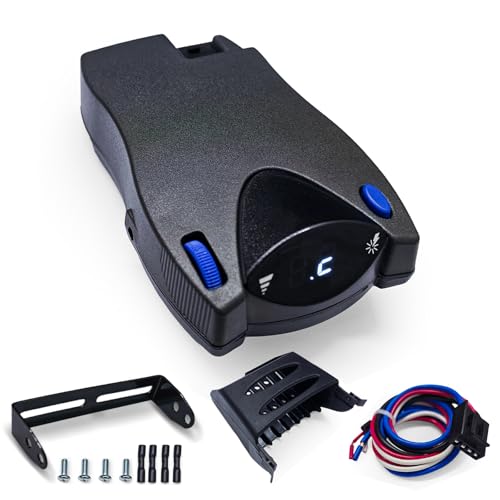
- Proportional braking uses internal sensors
- Supports up to 8 trailer brakes
- Includes boost, diagnostics, and manual override
Best For: Drivers seeking smoother braking and more control
Best Simple Display
Towpower 8507111 Time-Delayed Controller
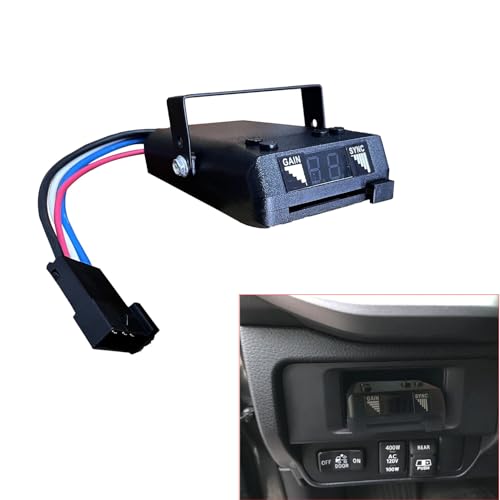
- Supports 1–4 trailer axles
- Adjustable time-delayed braking
- Includes bracket, screws, and instructions
Best For: Beginners wanting a compact, straightforward controller
Best Portable Pick
CURT Echo Bluetooth Controller

- Tool-free installation with a compatible powered 7-way
- Portable design transfers between vehicles
- Proportional braking for 1-2 axle trailers
Best For: Beginners seeking a portable, app-controlled setup
Best for Heavy-Duty Towing
briidea Proportional Brake Controller

- Handles trailers with 1-4 braked axles
- Display shows output, settings, and boost
- Includes fault and overcurrent protection
Best For: Frequent or heavy-duty trailer towing
Best Simple Self-Leveling Option
HocvrlX Proportional Controller

- Self-leveling calibration simplifies setup
- Offers three selectable boost modes
- Supports 1-3 axle trailers
Best For: Beginners wanting easy calibration and adjustable braking
Simple Time-Delay Pick – Pro Series 80500 POD
If you are shopping for a trailer brake controller for beginners, the Pro Series 80500 POD is a straightforward choice for light-duty towing. Its time-delay braking, readable display, and accessible controls keep setup and operation relatively simple.
Best For: Beginners towing trailers with 1-2 axles and 2 or 4 electric brakes.
Pros:
- Time-delay braking is suited to basic, light-duty towing.
- LED display shows power output and connection diagnostics.
- Can be mounted above or below the dash in any direction within the driver’s reach.
- Manual lever provides additional braking control.
Cons:
- Time-delay braking does not automatically mirror the tow vehicle’s braking intensity.
- Vehicle-specific Plug & Play wiring harness is sold separately.
The POD is a practical entry-level controller when simplicity matters more than proportional braking. Confirm your vehicle and trailer configuration before buying, and plan for the separate wiring harness if needed.
Proportional Value Option – 90160 Trailer Brake Controller
For beginners who want proportional braking, the 90160 adjusts trailer brake force according to how strongly the tow vehicle brakes. Its digital display, diagnostic alerts, and flexible mounting options make it approachable for everyday towing.
Best For: Drivers wanting proportional control for trailers with 1-3 axles and 2, 4, or 6 electric brakes.
Pros:
- Automatically varies trailer braking with vehicle braking intensity.
- LED screen provides settings and connection-status information.
- Self-diagnostics can alert users to connection or system issues.
- Includes snap-on and screw-in bracket options with 180-degree adjustment.
Cons:
- Vehicle-specific Plug-and-Play harness is not included.
- Compatibility and sizing should be checked before purchase.
This controller offers useful proportional behavior without giving up beginner-friendly visibility and manual adjustment. It is a strong fit for users who want more responsive braking than a basic time-delay unit provides.
Low-Profile Beginner Pick – CURT Venturer NEXT
The CURT 51116 Venturer NEXT is a beginner-friendly trailer brake controller for users who prefer a compact, adjustable time-delay design. It supports up to three axles and uses a low-profile bracket system that can help preserve dash clearance.
Best For: Beginners towing trailers with 2-6 brakes who want a compact, adjustable controller.
Pros:
- Low-profile design takes a less obtrusive approach to dash installation.
- Power and ramp time are fully adjustable.
- Operates 2-6 trailer brakes across 1-3 axles.
- No leveling is required, and it has no internal moving parts.
Cons:
- It uses time-delay braking rather than proportional braking.
- The supplied notes do not specify vehicle-specific harness inclusion.
The Venturer NEXT is a sensible option when installation flexibility and a clean, compact form are priorities. Its adjustable ramp and power settings let beginners tailor braking, though proportional control may better suit those seeking vehicle-braking response.
Broad-Capacity Proportional Pick – Timilge 8508211 Digital Controller
The Timilge 8508211 is a proportional trailer brake controller for beginners who need coverage across a wider range of trailer sizes. It provides an LED voltage display, adjustable braking and sync settings, and support for up to four axles.
Best For: Beginners and occasional towers needing proportional control for 1-4 axle trailers.
Pros:
- Proportional braking mirrors the tow vehicle’s braking intensity.
- Supports trailers with 2-8 brakes across 1-4 axles.
- LED display shows voltage delivered to the trailer brakes.
- Brake quantity and rate can be adjusted for trailer and road conditions.
Cons:
- Four-wire installation requires vehicle power, stop-light, ground, and trailer-brake connections.
- The controller should be powered down or disconnected when the truck is shut off or unused for long periods.
- The supplied notes do not identify a vehicle-specific harness as included.
This model is attractive when trailer capacity is the deciding factor, especially for users who may tow different trailer sizes. Beginners should review the four-wire connections and vehicle harness requirements before installation.
Best Beginner Value – briidea Time-Delay Trailer Brake Controller
For beginners seeking a trailer brake controller for beginners, the briidea BR-121 offers straightforward time-delay braking, a visible LED display, and safety alerts. It supports trailers with 1 to 4 braked axles and is positioned for light-duty or occasional towing.
Best For: New or occasional towers who want adjustable time-delay braking and basic onboard diagnostics.
Pros:
- Supports 1 to 4 braked axles, or 2 to 8 brakes.
- LED display shows gain settings, output voltage, and fault information.
- Includes overload, short-circuit, and fault detection protection.
- Mounting bracket and installation accessories are included.
Cons:
- Time-delay braking requires the driver to set the desired response rather than automatically matching deceleration.
- Described primarily for light-duty and occasional towing.
The briidea is a practical entry-level choice when simple controls and visible safety feedback matter more than proportional braking. Its broad axle support also leaves room to use it with different braked trailers.
Best Proportional Upgrade – 90885 Proportional Trailer Brake Controller
For beginners who want smoother automatic braking, this 90885 trailer brake controller uses internal sensors to apply trailer braking in proportion to the tow vehicle’s deceleration. It supports 1 to 4 axles and adds a digital display, manual override, boost settings, and diagnostics.
Best For: Drivers who want proportional braking and extra control for varied loads or frequent towing.
Pros:
- Automatically matches trailer braking to tow-vehicle deceleration.
- Supports 2, 4, 6, or 8 electric trailer brakes.
- Provides manual override, multi-level boost, and continuous diagnostics.
- Offers flexible mounting, a removable connector, and a two-year warranty.
Cons:
- Vehicle-specific plug-and-play harness is not included.
- Its additional controls and features may be more than occasional towers need.
This controller is the most feature-rich option in the group. Its proportional operation can make braking feel more natural, while the display and diagnostics give beginners useful feedback as they learn their setup.
Best Simple Display – Towpower 8507111 Time-Delayed Controller
The Towpower 8507111 is a compact time-delayed trailer brake controller for beginners who prefer uncomplicated adjustment. Its LED display shows braking force, and it is designed for vehicles and trailers using 1 to 4 axles, including common truck, SUV, RV, and bus applications.
Best For: Beginners who want a compact controller with adjustable braking force and a clear status display.
Pros:
- Supports 1 to 4 axles and 2-, 4-, 6-, or 8-brake systems.
- Time-delay activation helps provide smoother braking transitions.
- LED display shows current braking force for adjustment.
- Package includes a mounting bracket, screws, and instructions.
Cons:
- Time-delayed operation does not automatically proportion braking to deceleration.
- The supplied notes do not specify advanced diagnostics or overload protection.
The Towpower focuses on the essentials: broad compatibility, adjustable braking force, and a readable display. It is a sensible pick when you want a basic controller without emphasizing advanced features.
Best Portable Pick – CURT Echo Bluetooth Controller
For beginners who want a trailer brake controller without under-dash wiring, the CURT Echo is a convenient starting point. It plugs between compatible vehicle and trailer 7-way connectors, then uses the OneControl Auto app for setup and adjustments.
Best For: Beginners towing 1- or 2-axle trailers who need a portable controller that can transfer between compatible vehicles.
Pros:
- Installs without tools or under-dash wiring when the vehicle 7-way supplies the required power and ground.
- Proportional braking uses a triple-axis accelerometer for responsive control.
- App provides output and sensitivity adjustments, while programmed settings remain active if Bluetooth is lost.
Cons:
- Requires a compatible vehicle 7-way with active +12V power, ground, and turn-signal circuits.
- App control depends on Bluetooth communication and requires a compatible iOS or Android device.
- Hazard lights may require a specific app setting to prevent pulsing trailer-brake output.
The Echo is particularly approachable for first-time users who value portability, but buyers should verify 7-way power and app compatibility before purchasing. Always complete the pairing procedure and test braking before towing.
Best for Heavy-Duty Towing – briidea Proportional Brake Controller
The briidea Proportional Trailer Brake Controller is a practical choice for beginners who want a traditional in-cab controller with a display and physical controls. Its motion sensors match trailer braking to vehicle deceleration, while boost settings help accommodate different trailer loads.
Best For: Drivers towing 1- to 4-axle trailers, including travel, cargo, boat, and commercial trailers.
Pros:
- Supports 1 to 4 braked axles, or 2 to 8 brakes.
- Proportional braking and boost adjustment help provide smoother stops.
- LED display shows settings, output voltage, and boost levels.
- Includes overcurrent, short-circuit, and fault-detection protections.
Cons:
- Installation requires mounting the controller and associated accessories under the dashboard or elsewhere in the cab.
- It is less portable than a plug-in Bluetooth controller.
- The supplied notes recommend dashboard placement that avoids obstructing the driver’s view.
With broad axle support and straightforward buttons, the briidea is a versatile option for beginners who expect to tow larger or heavier trailers. Its display and manual switch also make in-cab monitoring and emergency control readily accessible.
Best Simple Self-Leveling Option – HocvrlX Proportional Controller
For beginners comparing a trailer brake controller for beginners, the HocvrlX proportional controller offers self-leveling calibration and three boost modes. It is designed for 1- to 3-axle trailers and lists compatibility with common tow vehicles, including Ford, GM, Chevy, Dodge, RAM, Toyota, Jeep, RVs, trucks, and SUVs.
Best For: Beginners who want self-leveling calibration and adjustable braking modes for changing trailer loads or road conditions.
Pros:
- Self-leveling calibration is designed to simplify setup.
- Three boost modes—Low, Medium, and High—allow braking-force adjustment.
- Supports 1- to 3-axle trailers.
Cons:
- Compatibility should be confirmed using the listed OEM part number, 90160, before purchase.
- The supplied notes provide fewer installation details than some competing controllers.
- Its stated axle range is narrower than controllers supporting up to four axles.
The HocvrlX is worth considering when self-leveling and simple boost selection matter more than maximum axle capacity. Confirm the vehicle and part-number fit before ordering, then adjust the boost mode to suit the trailer and load.
How We Picked the Best Trailer Brake Controller for Beginners
We focused on the features that matter most to first-time and occasional towers: braking response, installation method, axle compatibility, adjustability, display clarity, vehicle integration, and everyday ease of use. The selection includes time-delay and proportional controllers so you can compare simpler budget choices with smoother, more advanced systems.
We also considered practical safety features such as manual override controls, boost settings, self-leveling, overload protection, short-circuit alerts, and compatibility with standard 7-way trailer wiring. Always verify the controller’s vehicle and trailer compatibility before buying.
Quick Comparison
| Controller Type | Best For | Main Advantage | Potential Trade-Off |
|---|---|---|---|
| Time-delay | Budget-conscious beginners | Simple adjustment and lower cost | May require more manual tuning |
| Proportional | Frequent or varied towing | Braking generally matches the tow vehicle | Often costs more and may need careful setup |
| Plug-and-play | Compatible factory wiring | Faster installation | May still require a vehicle-specific harness |
| Bluetooth or mobile | Clean dashboards and flexible placement | Wireless control and app-based adjustment | Depends on phone, app, and power connectivity |
Key Buying Factors for a Trailer Brake Controller for Beginners
Choose the Right Braking Style
Time-delay controllers apply a preset braking level and are usually straightforward to operate. Proportional models sense how strongly the tow vehicle is slowing and apply trailer braking more naturally. For frequent towing, varying loads, or changing terrain, proportional control can provide a smoother feel.
Check Axle and Wiring Compatibility
Confirm that the controller supports your trailer’s number of braked axles. Several options in this roundup support one to three or four axles, while others are intended for smaller setups. Also check whether your vehicle has a factory brake-controller connector, a compatible 7-way socket, or requires additional wiring.
Look for Easy Adjustment and Visibility
A readable digital display, accessible gain control, manual override, and boost function can make setup easier. Self-leveling is useful if the controller’s mounting angle may change, while low-profile designs are helpful when dashboard space is limited.
Prioritize Safety Features
Overload and short-circuit alerts can help identify wiring or trailer-brake problems. Even with a quality controller, test braking at low speed after installation and adjust the gain gradually rather than starting at the highest setting.
Who Should Buy Which Trailer Brake Controller for Beginners?
- New or occasional towers: Choose an adjustable time-delay model if you want a simple, affordable introduction to trailer braking.
- Frequent towers: A proportional controller is usually the better long-term choice for smoother braking across different loads.
- Owners of multiple trailers: Look for broad axle support, easy gain adjustment, and a clear display.
- DIY installers: Plug-and-play compatibility can reduce installation time, but confirm the correct harness before ordering.
- Drivers who want a clean dashboard: A Bluetooth controller can provide flexible placement and mobile adjustment, provided the app experience suits your routine.
For any Trailer Brake Controller for Beginners, installation quality matters as much as the controller itself. Follow the manufacturer’s wiring instructions, confirm the trailer brakes are functioning, and recheck settings whenever the trailer load changes.