Plastic welders can turn cracked bumpers, broken tabs, tanks, and household plastic parts into repairable projects. The right tool depends on the plastic type, repair method, power, and accessories you need most.
We selected 10 plastic welding kits spanning hot staplers, soldering-style welders, hot-air tools, cordless models, and higher-powered repair systems so you can match the equipment to your workshop, vehicle, or DIY needs.
Best 10 Plastic Welders Picks for 2026
Versatile Staple Repair

- 1,000 staples in six styles
- Heats staples in 1–2 seconds
- Includes case and pliers
Best For: Multi-purpose automotive and household plastic repairs
2-in-1 Heat-and-Staple Kit

- 800 staples in four designs
- Includes rods, cutting, and smoothing tips
- Overheating protection included
Best For: Broad thermoplastic repair and DIY projects
UL-Certified Rod Welding

- UL-certified 80W welder
- Heats to a stated 525°F
- Includes rods, mesh, tape, and tips
Best For: Conventional rod welding with added certification
Cordless Hot Stapling

- Cordless hot-staple pen
- Inline and 90-degree insertion
- Includes ABS, PP, and PE sticks
Best For: Portable vehicle and powersports plastic repairs
Best All-Around Hot Stapler

- 100-watt hot-stapler design for fast repairs
- Works on bumpers, dashboards, radiators, and more
- Ergonomic handle with overheating protection
Best For: Automotive repairs and reinforced DIY plastic fixes
Best for Large-Scale Plastic Welding

- 1600-watt output with 40°C–650°C adjustment
- Multiple nozzles, roller, and groover included
- Designed for roofing, flooring, tarps, and thermoplastics
Best For: Seam sealing and larger thermoplastic repair projects
Best Budget 2-in-1 Kit

- Combines plastic welding and soldering functions
- Includes 56 rods in seven plastic types
- Three heat settings with repair accessories
Best For: Home users handling varied plastic and light soldering repairs
Best Hot Staple Kit

- 200 assorted hot staples included
- LED light for low-light repairs
- Overheating protection and one-year support
Best For: ABS bumper and household plastic crack repairs
Best All-in-One Kit

- Supports staples and plastic rods
- 1,002 staples plus 100 rods included
- LED light and overheating protection
Best For: Multi-material automotive and DIY plastic repairs
Best Cordless Option
Portable Cordless Plastic Welding Gun
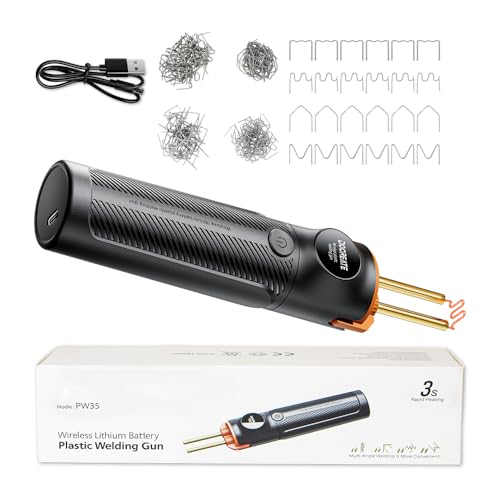
- 4,000mAh battery-powered operation
- Heats in about three seconds
- Adjustable angles and 400 staples
Best For: Portable bumper repairs and DIY projects
Versatile Staple Repair – ATOLS Plastic Welder Kit
If you need plastic welders for automotive and household repairs, the ATOLS kit is a versatile staple-based option. It heats staples in about 1–2 seconds and includes six staple styles for reinforcing bumpers, dashboards, lamp holders, radiators, spoilers, handles, and other plastic parts.
Best For: DIYers repairing a wide range of automotive, motorcycle, kayak, and household plastic components.
Pros:
- Includes 1,000 stainless steel staples in six shapes and sizes.
- Rapid 1–2-second staple heating with a front operating light.
- Ergonomic rubber handle, pliers, and portable carrying case included.
Cons:
- Corded AC operation limits use away from an outlet.
- Designed primarily for staple reinforcement rather than general plastic-rod welding.
With its broad staple selection and compact case, this ATOLS plastic welder is a practical choice for repeated crack and split repairs. The different staple profiles make it easier to match the reinforcement to the repair area.
2-in-1 Heat-and-Staple Kit – Allturn Plastic Welder
The Allturn is one of the more flexible plastic welders for DIY repair work because it combines hot stapling with plastic-rod welding and auxiliary smoothing and cutting tips. Its staples heat in about one to two seconds, while the hot smoothing head reaches its stated maximum temperature in about five seconds.
Best For: Users who want a broad repair kit for thermoplastic parts, including bumpers, dashboards, tanks, radiators, and DIY projects.
Pros:
- Includes 800 staples across flat, wavy, M-type, and V-type designs.
- Comes with 38 plastic welding rods, a cutting tip, smoothing tips, and knife.
- Internal overheating protection and UL-certified power cord add safety features.
- Portable suitcase includes pliers, sandpaper, and wire mesh.
Cons:
- Hot cutting and smoothing tips should be used for no more than five minutes at a time.
- The 3.39-pound kit is heavier than some simpler plastic welders.
This Allturn kit suits buyers who want more than a basic staple gun. Its combination of staple patterns, welding rods, and hot accessories expands the types of repairs you can attempt, provided you follow the cooling guidance.
UL-Certified Rod Welding – Standard Plastic Welding Kit
For shoppers comparing plastic welders for rod-based repairs, this UL-certified 80-watt kit offers a straightforward setup. It heats to a stated 525°F and includes welding rods, triangle tips, wire mesh, aluminum tape, and sandpaper for repairs on automotive parts, boats, tanks, and other plastic items.
Best For: Buyers who prioritize a UL-certified corded tool and conventional plastic-rod welding for common thermoplastics.
Pros:
- UL-certified welder, factory, and production process.
- Supports listed plastics including HDPE, LDPE, PP, ABS, PE, TPO, and PA.
- Includes two triangle tips, mesh, tape, rods, and sandpaper.
- Backed by a one-year manufacturer warranty and US customer service.
Cons:
- Includes only 20 black welding rods.
- Reaches operating heat in a few minutes rather than almost instantly.
- Corded design requires access to a 110–120V outlet.
This is a focused option for users who prefer plastic rods and a conventional welding iron over hot-staple repairs. Its certification and included preparation materials make it a sensible starter kit for planned repair projects.
Cordless Hot Stapling – Astro Tools 7601 Repair Kit
The Astro Tools 7601 is a convenient choice among plastic welders when portability matters. This cordless hot-staple pen heats included staples to a stated 1,022°F and supports both inline and 90-degree staple insertion, helping you reach different repair angles on vehicles, boats, ATVs, and other plastic components.
Best For: Mobile repairs on bumpers, headlight fittings, clips, tabs, panels, dash pieces, and similar plastic parts.
Pros:
- Cordless design is useful for repairs away from a wall outlet.
- Supports inline and 90-degree staple insertion for access flexibility.
- Includes ABS, PP, and PE welding sticks plus multiple staple styles.
- Welding head, stand, and USB-C charging cable are included.
Cons:
- The supplied notes do not specify battery runtime or charging time.
- Its hand-powered listing provides less electrical detail than the corded alternatives.
- Staple and welding-head repairs may require different finishing steps.
Choose the Astro Tools kit if portability and access are more important than a large staple inventory. Its angled insertion options and included welding materials make it particularly practical for vehicle and powersports repairs in hard-to-reach areas.
Best All-Around Hot Stapler – Allturn 2-in-1 Plastic Welder
If you need plastic welders for quick repairs to bumpers, dashboards, lamp holders, or other plastic parts, the Allturn combines hot-staple reinforcement with a compact 100-watt gun design. Its ergonomic rubber handle and built-in overheating protection make it practical for occasional DIY and automotive work.
Best For: Car bumper repairs, plastic part reinforcement, and general DIY fixes where hot staples can strengthen a cracked area.
Pros:
- Hot-stapler design helps reinforce damaged plastic quickly.
- Suitable for bumpers, dashboards, radiators, rings, and various plastic products.
- Ergonomic rubber handle and portable design support more comfortable use.
- Internal overheating protection pauses operation if the tool gets too hot.
Cons:
- It is a corded 110-volt tool with a 63-inch cord.
- Its 100-watt design is more suited to localized plastic repairs than large hot-air welding jobs.
The Allturn is a focused choice among plastic welders when speed, reinforcement, and straightforward operation matter most. Choose it for repair work that benefits from embedded staples rather than broad surface heating.
Best for Large-Scale Plastic Welding – 1600W Hot Air Welder Kit
For users comparing plastic welders for roofing, flooring, tarps, or thermoplastic sheets, this 1600-watt hot-air model offers adjustable heat and a broad accessory selection. Its included nozzles, roller, and groover support seam sealing, shaping, and different welding tasks.
Best For: TPO and vinyl roofing, pool liners, tarps, vinyl flooring, tanks, boat repairs, and other larger thermoplastic projects.
Pros:
- 1600 watts and adjustable temperature from 40°C to 650°C.
- Includes flat, round, and speed-welding nozzles plus a silicone seam roller.
- Supports PVC, PE, PP, PVDF, and similar plastic materials.
- Automatic cooling system helps reduce heating-element stress.
Cons:
- The larger 4.77-pound kit may be less convenient for small repairs.
- It requires practice to select heat settings without burning plastic.
- The manufacturer recommends cooling procedures before powering it off.
This is the most capable option here for seams, membranes, and sheet materials. Its power and accessories add versatility, but beginners should start carefully and follow the recommended cooldown procedure.
Best Budget 2-in-1 Kit – 100W Plastic Welder with Rods
This 100-watt option is one of the more versatile plastic welders for home workshops because it combines plastic repair tips with soldering-iron functionality. It also includes 56 rods in several plastic types, mesh, foil tape, sandpaper, and basic maintenance accessories.
Best For: Residential repairs to car bumpers, dashboards, kayaks, and other plastic items when you want both welding and light soldering capability.
Pros:
- 2-in-1 design works as a plastic repair tool and soldering iron.
- Three temperature settings and a 100-watt heater provide quick warm-up.
- Includes 56 rods covering ABS, PP, PE, TPE, PC, PUR, and PA.
- Comes with mesh, foil tape, sandpaper, a stand, and cleaning tools.
Cons:
- Three temperature settings offer less adjustment than a variable-temperature tool.
- The manufacturer notes that a small amount of smoke may appear during first use.
- It is intended for corded residential use.
Choose this kit when material variety and included extras are more important than high output. The soldering function makes it a useful general-purpose repair tool, while the supplied rods reduce the need to buy consumables separately.
Best Hot Staple Kit – WEP 960-V Plastic Welder
If you need a straightforward tool for repairing bumper cracks and other ABS plastic parts, this plastic welder kit focuses on hot-staple reinforcement. Its built-in LED light, included cutters, and 200 assorted staples make it a practical choice for common automotive and household repairs.
Best For: Mechanics and DIY users repairing ABS bumpers, dashboards, plastic tanks, and similar parts.
Pros:
- Includes 200 staples in four shapes for different crack types.
- Built-in LED light improves visibility at the repair point.
- Overheating protection and a 53.9-inch US-specification power cord.
- Includes pliers and one year of US technical support.
Cons:
- Supports 110–127V USA power only; it should not be connected to 220V.
- Designed primarily for hot-staple repairs rather than rod welding.
- Plastic welding produces fumes, so protective respiratory equipment is recommended.
The WEP 960-V is a focused, easy-to-equip option for staple-based plastic repairs. Choose it when dependable ABS crack reinforcement and a compact kit matter more than having multiple welding methods.
Best All-in-One Kit – 220W Plastic Welder
For shoppers who want both hot-staple and plastic-rod repairs, this 220W plastic welder offers a broad accessory package. It includes 1,000 hot staples, 100 plastic rods, mesh, smoothing tips, and cleaning accessories for working on several plastic types.
Best For: DIYers and automotive users who want a versatile kit for bumpers, dashboards, kayaks, toys, bins, and other plastic items.
Pros:
- Provides two repair methods: hot staples and plastic welding rods.
- Includes 1,002 staples across six shapes and sizes.
- Comes with 100 rods covering materials such as ABS, PP, PE, TPE, and TPO.
- 220W output, rapid heating, LED lighting, and overheating protection.
Cons:
- The corded 110V design is less portable than a battery-powered welder.
- The large accessory assortment may be more than needed for occasional repairs.
- Material matching is still required when selecting a plastic welding rod.
This is the most versatile option of the three for users who expect to repair different plastics and want both staple reinforcement and rod welding in one package. Its corded design makes it better suited to workshop or garage use.
Best Cordless Option – Portable Cordless Plastic Welding Gun
This cordless plastic welder is built for portable repairs where access to an outlet is inconvenient. Its 4,000mAh lithium-ion battery, three-second heating time, adjustable welding angles, and 400 assorted staples support quick bumper repairs and DIY projects.
Best For: Mobile repairs, roadside or outdoor work, and DIY users who value cordless convenience.
Pros:
- Battery-powered design works without a wall outlet.
- Heats in approximately three seconds for quick use.
- Adjustable welding angles help reach difficult areas.
- Includes 400 staples in four shapes and a USB charging cable.
Cons:
- Offers hot staples but does not list plastic welding rods among the included accessories.
- Battery runtime and charging time are not specified in the supplied details.
- Its smaller staple assortment is less extensive than the larger corded kit.
The cordless design is the key advantage here. Select this plastic welder when portability and fast startup are more important than a large selection of accessories or rod-welding capability.
How We Picked These Plastic Welders
We focused on the features that have the greatest effect on practical repair work: heating performance, control, included welding tips or staples, ergonomics, power source, safety certifications where listed, and the types of plastic repairs each tool can handle. The selection includes compact kits for occasional bumper fixes, versatile 2-in-1 tools, cordless options for mobile work, and hot-air welders for larger sheets or thermoplastic materials.
Because product specifications and included accessories can vary by seller, confirm the latest wattage, voltage, temperature range, staple count, and replacement-part availability before ordering.
Quick Comparison
| Best For | Look For |
|---|---|
| Bumper tabs and cracks | Hot stapler, multiple staple shapes, comfortable pliers |
| Small plastic repairs | Adjustable heat, soldering-style tips, compact design |
| Large panels or sheet plastic | Hot-air output, suitable nozzle, compatible welding rod |
| Mobile or roadside work | Cordless battery, fast warm-up, included staples |
| Frequent workshop repairs | Durable construction, replaceable parts, consistent temperature |
Key Buying Factors for Plastic Welders
Repair Method
Hot staplers reinforce cracks by embedding heated metal staples across the damaged area. They are especially useful for automotive bumpers and mounting tabs. Soldering-style Plastic Welders melt a groove or plastic rod, while hot-air welders soften the base material and filler for broader seams. Choose the method that matches the repair rather than relying on wattage alone.
Power and Temperature Control
Higher wattage can mean faster heating and better recovery, but excessive heat can scorch thin plastic. Adjustable temperature or speed settings provide more control across different materials. Check whether the tool is designed for your outlet voltage, particularly with 110V workshop equipment.
Accessories and Compatibility
A large staple assortment improves flexibility, but staple shape and leg length still matter. For rod-based repairs, verify that the kit includes compatible filler rods or that replacements are easy to source. Useful extras include pliers, cutters, smoothing tips, storage cases, and LED work lights.
Safety and Handling
Look for insulated handles, stable controls, manageable cable length, and credible safety certification where available. Work in a ventilated area, wear eye protection and heat-resistant gloves, and test an unseen section first. Identify the plastic whenever possible, since some materials release hazardous fumes when heated.
Who Should Buy Which Plastic Welders?
Choose a hot-stapler kit if your main goal is repairing car bumpers, tabs, grilles, or cracked plastic housings. Choose a 2-in-1 or adjustable soldering-style model if you want one compact tool for small repairs and plastic rod work. Choose a hot-air plastic welder for larger seams, vinyl, PVC, TPO, roofing materials, or sheet-plastic fabrication.
Choose a cordless plastic welder for field repairs, vehicle work away from an outlet, or improved portability. For regular workshop use, prioritize consistent heating, replaceable accessories, and a comfortable grip over the largest accessory count. Beginners should favor a kit with clear controls and several staple or tip options, while experienced users may benefit more from specialized nozzles, higher output, and broader material compatibility.