FOXWELL BT705Plus review is about a very specific kind of buyer: someone who wants one tool for battery health, cranking checks, and charging-system diagnosis.
If you need a compact tester for cars, trucks, boats, RVs, or other 12V/24V vehicles, this model is built around that workflow.
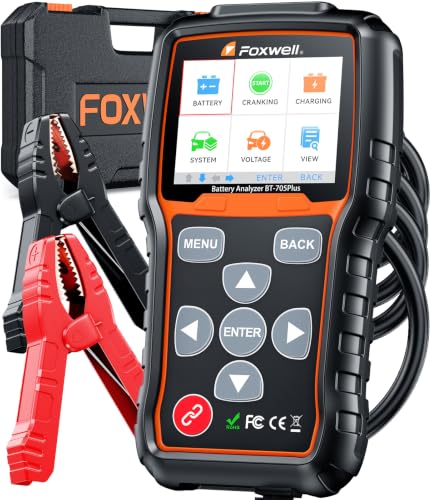
BT705Plus Review Summary
The FOXWELL BT705Plus makes sense for drivers, DIYers, mechanics, and fleet users who want a single handheld tester that covers the most common electrical questions before a no-start event becomes a roadside problem.
Its main appeal is breadth plus simplicity: battery, cranking, and charging tests are all available in one unit, and the listing emphasizes faster processing, clearer readings, and easier use in low-light or outdoor settings.
That combination matters if you are tired of guessing whether a weak start comes from the battery, the starter, or the alternator.
The BT705Plus is also a better fit than a basic battery checker if you want more than a simple voltage snapshot.
It is meant to help you identify weak batteries, starting problems, charging ripple, and alternator issues in a more complete diagnostic flow.
Review Scorecard
| Category | Score | Buyer-focused rationale |
|---|---|---|
| Diagnostic breadth | 9/10 | Covers battery, cranking, and charging tests in one tool, including SOH, SOC, cranking voltage/time/CCA, and ripple. |
| Ease of use | 8/10 | The color LCD, five indicators, and long cables are aimed at simpler solo testing. |
| Vehicle compatibility | 9/10 | Supports 12V/24V systems and multiple battery types except lithium, which broadens real-world use. |
| Practical service value | 8/10 | Useful for spotting weak batteries and charging problems before they become breakdowns or towing events. |
| Readability | 8/10 | The listing highlights a high-contrast 2.8-inch color display for indoor or outdoor use. |
| Solo workflow | 9/10 | The 5.9 ft cables and in-vehicle testing guidance make it realistic to use without a helper. |
| Scope of ownership | 8/10 | Good for home garages, shops, and fleet checks, though the lithium exclusion narrows some EV-adjacent use cases. |
Key Features and Specifications of BT705Plus
The BT705Plus is an upgraded version of FOXWELL’s BT705.
According to the listing, it uses a more powerful processor and refined algorithms, with results up to 30% faster than the original model.
The practical benefit is not just speed for its own sake; it is faster confirmation when you are trying to decide whether a vehicle issue is battery-related or part of a broader charging problem.
Here are the key points that matter most for buyers:
- Supports 12V and 24V vehicle systems.
- Works with Flooded, AGM, Spiral, and GEL batteries.
- Not intended for lithium batteries.
- Measures battery, cranking, and charging performance.
- Reports metrics such as SOH, SOC, cranking voltage/time/CCA, and charging ripple.
- Uses a 2.8-inch color LCD with high-contrast readouts.
- Includes five diagnostic indicators shown at a glance.
- Comes with 5.9 ft cables for easier solo testing.
- The listing says it is suitable for cars, trucks, RVs, boats, heavy-duty vehicles, and tractors.
- The package includes the tester and a storage box.
Two usage details in the listing are worth noting because they affect real-world results.
First, you need to enter the battery’s rated CCA value from the label.
Second, in-vehicle testing works best when accessory loads are off, the ignition is off, and the doors are closed.
Those are normal requirements for electrical testing, but they are still worth remembering because they affect repeatability.
If your goal is a quick yes/no battery check, this product is probably more tool than you need.
If your goal is to understand whether the battery, starter, or alternator is the likely weak link, the BT705Plus is much closer to the right class of tool.
Pros and Cons of BT705Plus
Pros
- Broad diagnostic coverage across battery, cranking, and charging systems.
- Compatible with common lead-acid battery types across 12V and 24V vehicles.
- Color display and five indicators make results easier to read quickly.
- Long cables support testing from the driver’s seat in many vehicles.
- The upgraded processor and algorithm changes are positioned as a faster, more refined experience.
Cons
- Not for lithium batteries, so it is not universal.
- It still depends on entering the battery’s rated CCA correctly.
- The feature set is more advanced than a simple consumer voltage checker, so casual buyers may not use all of it.
- The listing promises speed and accuracy improvements, but those are manufacturer claims rather than independently verified lab results here.
Who Should Buy BT705Plus?
The BT705Plus is a strong fit for buyers who regularly deal with battery-related uncertainty.
That includes home mechanics, roadside-prevention-minded drivers, small repair shops, used-car managers, and fleet operators who want to check batteries before a vehicle goes out on the road.
It is especially useful if you want to test more than one part of the starting/charging chain without buying separate tools.
It also makes sense if you work on multiple vehicle types.
The 12V/24V support and broad lead-acid compatibility make it more flexible than testers aimed only at passenger cars.
You should probably skip it if you only need the occasional basic battery check, if you work primarily with lithium battery systems, or if you want a tool with the smallest possible learning curve.
The BT705Plus is still straightforward, but it is built for people who care about diagnostics, not just a quick voltage reading.
Battery Diagnostics and Real-World Use of BT705Plus
Battery Health Checks
The strongest use case here is routine battery evaluation.
Because the tester reports SOH and SOC, it gives a more useful view than a simple voltage reading when you are trying to understand whether a battery is aging, weak, or just undercharged.
That matters before winter, after long storage, or after a vehicle sits unused.
Cranking and Starting Diagnosis
The cranking test is where the BT705Plus starts to separate itself from simpler tools.
A weak crank can come from the battery, but it can also reflect starter load or connection problems.
Having voltage/time/CCA-related data helps narrow the problem instead of guessing.
For anyone chasing intermittent no-start complaints, that saves time.
Charging and Alternator Checks
Charging-system testing is another practical strength.
If a battery keeps going flat, the real issue may be the alternator or a ripple problem rather than the battery itself.
The BT705Plus is designed to surface those questions in one workflow, which is more useful than swapping parts blindly.
Solo Testing Convenience
The 5.9 ft cables are a small detail that matters in use.
If you can sit in the driver’s seat while running a test, the tool becomes easier to use consistently.
That does not change the diagnostic method, but it improves the odds that people will actually test before a problem leaves them stranded.
Alternatives to BT705Plus
If you want a simpler battery-focused tool, the ANCEL BA101 is a common comparison point.
If you want a well-known shop-style name in the same broad category, the Midtronics battery tester lineup is worth looking at.
If you want another consumer-friendly diagnostic option, the TOPDON battery tester line is a credible alternative to compare.
If you want a basic handheld check rather than a deeper diagnostic tool, the FOXWELL battery tester range includes other models that may be simpler or more specialized.
Is BT705Plus Worth It?
The FOXWELL BT705Plus is worth it if you want a serious battery and charging-system tester that can cover 12V and 24V vehicles, multiple lead-acid battery types, and the full battery-cranking-charging workflow in one handheld unit.
It is a practical buy for anyone who values early diagnosis over guesswork.
If you only need a quick battery health check, it may be more tool than you need.
If you want one tester that helps explain weak starts, charging faults, and battery condition in a more complete way, the BT705Plus is a sensible choice.