If you want a 10-inch under-seat car subwoofer review focused on practical fit rather than flashy marketing, this model is easy to evaluate.
It is built for drivers who want real low-end support in a space-saving form factor.
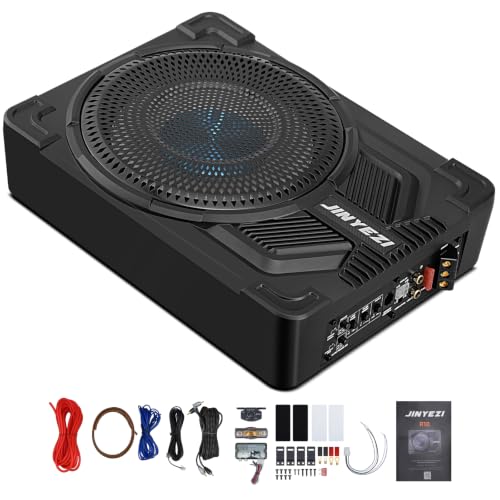
Under-Seat Subwoofer Review Summary
This 10-Inch 1200W Under-Seat Car Subwoofer makes the most sense for buyers who need stronger bass in a truck, SUV, MPV, UTV, or other cabin where a full enclosure would be awkward.
The listing points to a compact active design, a thickened aluminum housing, and a Class D amplifier platform aimed at efficient power delivery and lower heat.
That combination is especially relevant if you are upgrading from weak factory bass but do not want to sacrifice legroom or cargo space.
The product is not trying to be a giant boom-box replacement.
It is aimed at controlled, integrated bass support.
That matters because under-seat subwoofers are usually judged less by sheer output claims and more by whether they can add audible low-frequency weight without rattling, overheating, or creating installation headaches.
Based on the supplied specifications, this model looks strongest for buyers who value compactness, protection features, and straightforward integration with factory audio systems.
Review Scorecard
| Category | Score | Buyer-focused rationale |
|---|---|---|
| Space efficiency | 10/10 | The under-seat design is explicitly built to preserve legroom and cargo space. |
| Power delivery | 8/10 | The upgraded IRS2095 + IRL540N Class D amplifier is positioned for efficient bass output. |
| Thermal management | 9/10 | Thick aluminum housing and dual-sided heat dissipation are strong signs for sustained use. |
| System compatibility | 9/10 | Built-in high-to-low converter and REM wire support factory head unit integration. |
| Protection features | 9/10 | Thermal, short-circuit, and overload protection reduce installation risk. |
| Tuning flexibility | 8/10 | Adjustable bass boost and a wide low-pass filter range help tailor the response. |
| Overall value fit | 8/10 | The feature set is well matched to compact vehicles and OEM-upgrade buyers. |
Bottom line: this is a smart buy if your main goal is compact, reliable bass enhancement rather than the biggest possible cabin-shaking output.
Key Features and Specifications of Under-Seat Subwoofer
The headline feature is the space-saving chassis.
The listing says the unit fits under most vehicle seats and is meant to avoid bulky enclosures.
That alone will matter more than any wattage claim for many buyers, because a subwoofer that fits cleanly is more likely to stay installed and get used.
The amplifier stage is described as an upgraded IRS2095 IC + IRL540N MOSFET Class D design.
The listing claims up to 95% power conversion efficiency, which is a good sign for heat-conscious installations.
In plain terms, efficient amplification is useful in a cramped under-seat environment because it helps the unit do its job without turning the cabin into a heat trap.
The stated technical details are straightforward:
| Spec | Detail |
|---|---|
| Woofer impedance | 2 ohms |
| RMS power | 280W |
| Frequency response | 20Hz-180Hz |
| Low-pass filter | 40Hz-180Hz |
| Bass boost | 0-12dB |
| Fuse | 40A |
| SNR | >90dB |
| THD | <0.3% (20Hz-180Hz) |
| Dimensions | 13.38 x 10.03 x 3 inches |
| Inputs | High-level and low-level |
Those numbers suggest a product designed for controlled bass reinforcement rather than pure overkill.
The 40Hz-180Hz low-pass range is broad enough for tuning, while the 0-12dB bass boost gives some room to compensate for weak factory low end.
The built-in high-to-low level converter is also important because it reduces the friction of adding bass to an OEM system that does not already have RCA outputs.
There are also several protection and hardware details that are worth noting.
The listing mentions 8AWG cables, copper terminals, oxygen-free copper RCA cables, and integrated thermal, short-circuit, and overload protection.
Those are not glamorous features, but they are the parts that usually decide whether a compact sub becomes a dependable upgrade or a troubleshooting project.
Pros and Cons of Under-Seat Subwoofer
Pros
- Compact fit: the under-seat format is the main reason to buy it, and the listed dimensions support that use case.
- Efficient Class D design: high-efficiency amplification should help with heat and power management.
- Flexible input support: high-level and low-level inputs make it easier to use with factory or aftermarket head units.
- Protection features: thermal, short-circuit, and overload protection are practical safeguards.
- Useful tuning controls: bass boost and low-pass filtering help you shape the response for the vehicle.
- Solid materials focus: the aluminum housing and copper-based cabling point toward a durability-first design.
Cons
- Not for maximum-output seekers: this is a compact under-seat sub, so it is not the right category for huge SPL goals.
- Fit still needs checking: even though the design is space-saving, under-seat clearances vary by vehicle.
- Bass quality depends on setup: strong specs do not replace careful gain, crossover, and source tuning.
- No hands-on evidence here: the conclusion has to rely on listing data, not measured in-car testing.
Overall, the strengths are practical ones.
If you want a tidy install and a noticeable bass lift, the positives are meaningful.
If you want a showpiece subwoofer or extreme output, the format itself is the limitation.
Who Should Buy Under-Seat Subwoofer?
This Under-Seat Subwoofer fits buyers who want low-frequency support without redesigning the trunk or giving up storage.
That includes truck owners, SUV drivers, and anyone with a cramped cabin who still wants bass that is more substantial than the factory system delivers.
It is also a reasonable choice for people using a stock head unit.
The built-in high-to-low converter and REM wire support are specifically helpful when you are not starting with a clean aftermarket audio chain.
For a lot of buyers, that is the difference between an upgrade they can actually install and one that stays in the cart.
You should skip it if you are chasing the loudest possible bass, if your vehicle has very little seat clearance, or if you already have a full subwoofer system that does the job.
This is a space-efficiency product first.
The value comes from integration and convenience, not brute force.
Installation and Tuning for Under-Seat Bass
Factory Head Unit Integration
The built-in high-to-low level converter is a real selling point for OEM systems.
It means the product is designed to accept signal from factory audio setups without forcing you to add a separate converter first.
Heat and Continuous Use
The thickened aluminum housing and dual-sided heat dissipation channels suggest the manufacturer is aware of the main weakness of compact powered subs: heat buildup.
That makes this model more appealing for longer drives or repeated use than a cheaper, less ventilated unit.
Filter and Gain Setup
The 40Hz-180Hz low-pass range and 0-12dB bass boost give enough adjustment for most cabin-tuning needs.
The useful approach here is restraint: set the crossover to support the main speakers rather than trying to make the sub do everything.
Alternatives to Under-Seat Subwoofer
If you want a similar Amazon-searchable alternative, compare it with a Rockville under-seat powered subwoofer: Rockville under-seat powered subwoofer.
Another credible option is a Pioneer compact powered subwoofer: Pioneer compact powered subwoofer.
You can also look at JBL under-seat powered subwoofer models if you want a compact branded route: JBL under-seat powered subwoofer.
For buyers who care more about install depth and a small footprint than brand loyalty, a Kenwood compact powered subwoofer is worth comparing: Kenwood compact powered subwoofer.
Is Under-Seat Subwoofer Worth It?
For the right buyer, yes.
The 10-Inch 1200W Under-Seat Car Subwoofer looks worth considering if you want compact, integrated bass with factory-head-unit compatibility, thermal safeguards, and tuning flexibility.
It is not the best pick for maximum output or dramatic trunk-rattling performance.
It is a better fit for drivers who want a practical, space-conscious bass upgrade that can live under a seat and do its job without demanding a full system rebuild.